— Therapeutic Bodywork · McLean, VA
Deep Tissue Massage in McLean, VA.
Real pressure, applied by licensed practitioners who know where to put it. Our deep tissue work is delivered inside a 60 minute meridian massage — firm enough to change something, adjusted so you never have to grit your teeth through it.
Quick answer
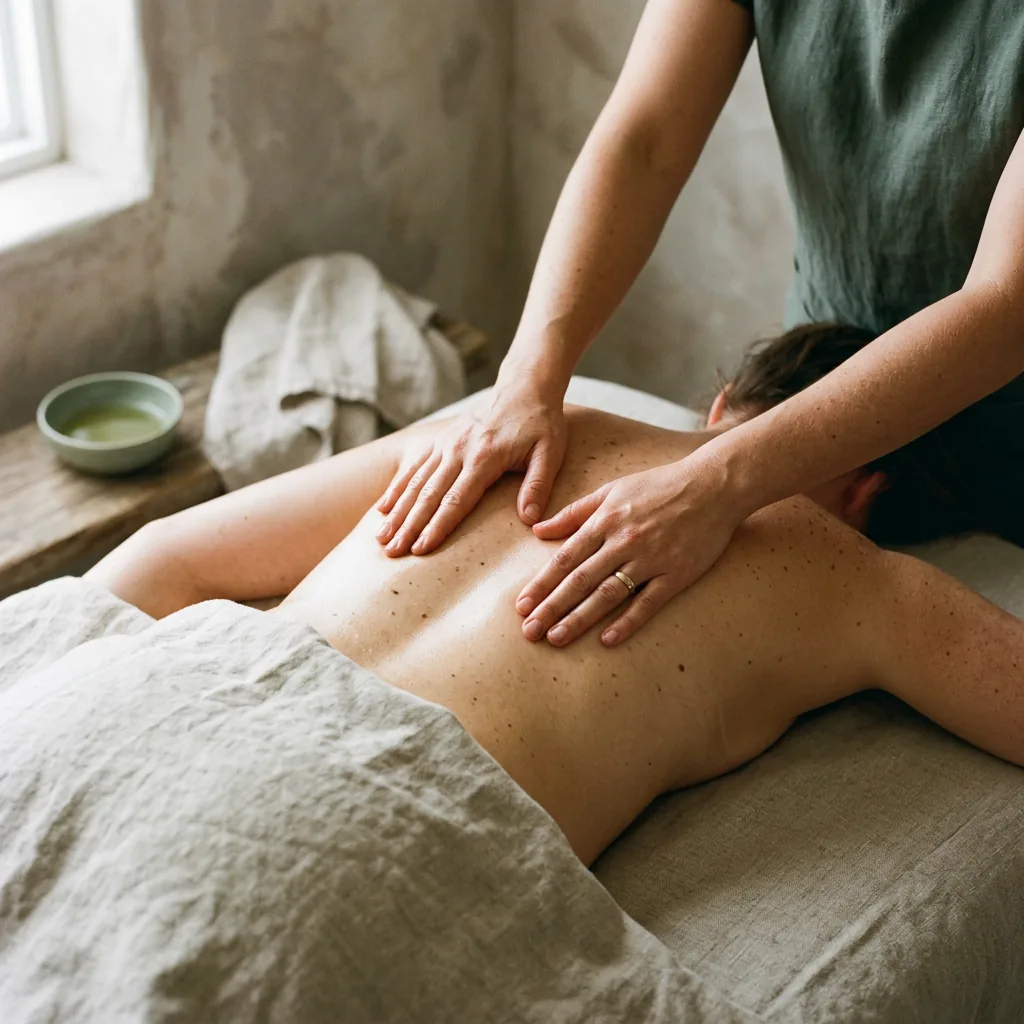
Deep tissue massage is firm, slow bodywork that works into the deeper layers of muscle and the fascia around it, rather than gliding over the surface. At Harmony Acupuncture & Wellness Spa, 1481 Chain Bridge Rd, Ste 300 in McLean, VA, deep tissue massage is a 60 minute session on our massage menu — $100, or $80 for members. It is our meridian and tui na bodywork delivered at firm pressure, priced the same as every other 60 minute massage, so there is no upcharge for asking for deep tissue. Open 7 days, 9 AM to 9 PM, with free parking at the door. Text to book and tell us where it hurts. Research suggests massage may help with muscle tension and pain for some people; results vary, and it is not a treatment for injury or disease.
- Session
- $100 · 60 minutes
- Member rate
- $80 · 60 minutes
- Pressure
- Firm — set by you, adjusted any time
- Hours
- 7 days · 9 AM – 9 PM
— 01
What deep tissue massage actually is.

Deep tissue massage is not a brand of massage so much as a description of intent. The therapist works slowly, with sustained pressure, into muscle below the surface layer and into the fascia — the connective sheet that wraps and separates muscle. Instead of long gliding strokes across the whole back, the work narrows: forearm, elbow, knuckle or thumb held on one band of tissue while it releases, then moved a few centimetres and held again.
The pace is the part people underestimate. Deep tissue is slow because muscle does not respond well to force applied quickly — it braces. Pressure that arrives gradually and stays put gives the nervous system time to let go, which is why a good deep tissue hour often covers less territory than a relaxation massage and still leaves you feeling like more happened.
How we deliver it here
Plainly, because this matters: deep tissue massage is its own line on our menu — 60 minutes, $100, or $80 for members — and it is priced identically to every other massage we offer. The hands doing it are trained in meridian and tui na massage, a Traditional Chinese Medicine bodywork tradition that has always worked at real therapeutic pressure: thumbs, forearms, elbows, along the channels TCM maps. Book deep tissue and that is the hour you get. Nobody charges you extra because you asked for firm.
That last part is worth pausing on, because it is not how the pressure question is usually priced. At a lot of studios and franchises, deep tissue sits a tier above the standard hour, so the rate on the sign is not the rate on the receipt. Here the menu is flat and published: the local range, and where $100 sits inside it, is laid out on our McLean massage prices page.
The difference from a generic deep tissue hour is the assessment in front of it. Your practitioner asks what you do all day, where the pain actually sits versus where you feel it, and what makes it worse — then works the pattern rather than only the sore spot. A right shoulder that screams is often being pulled by a mid-back that never complains.
— 02
What it may help, and what it won't.
People book deep tissue massage in McLean for a fairly narrow list of reasons, and the honest framing is that it addresses muscular tension well and diagnosed conditions not at all.
- Desk and screen tension — the band across the upper back and neck that builds through a week of Tysons meetings. This is the single most common reason people walk in.
- Tight hips and low back from sitting — long commutes on the Beltway and 495 do a specific kind of damage to hip flexors.
- Training soreness — runners on the GW Parkway trails, lifters, tennis and golf players who want the tissue worked between sessions.
- Long-standing knots — the spot between the shoulder blade and spine that a foam roller cannot reach.
- Stress that lives in the body — a clenched jaw and hiked shoulders are muscular even when the cause is not.
What deep tissue massage is not
It is not a treatment for an injury. A torn muscle, a disc problem, a frozen shoulder or nerve pain needs a physician or a physical therapist, and pressing harder on any of them can make things worse. It does not remove toxins — that is your liver and kidneys, not a pair of hands. It will not permanently fix posture built over fifteen years of desk work, though it can make the retraining considerably more comfortable.
If your pain is nerve-flavoured — burning, shooting, numb, tingling down a limb — say so at intake. That pattern often points somewhere else entirely, and our pages on sciatica and neck and shoulder pain are the better starting point.
Where the evidence sits
Modest and worth stating accurately. The National Center for Complementary and Integrative Health reports that massage therapy may help with some pain conditions and with stress, while noting that study quality varies widely and that effects are often short-term. That is a real benefit, not a miracle, and it is the level at which we will describe it to you on the phone.
— 03
How much pressure is right?

The most common mistake in a deep tissue session is the client enduring pressure they hate because they think that is the deal. It is not. Useful pressure sits at the edge of comfortable — you notice it, you can still breathe normally, and you are not gripping the table. Pain that makes you hold your breath causes the muscle to brace, which is the opposite of what the hour is for.
| Level | What it feels like | Best for |
|---|---|---|
| Light | Barely more than the weight of a hand — closer to our lymphatic drainage | Fluid, puffiness, nervous-system calm |
| Medium | Clear pressure, easy to talk through | General tension, first massage in a while |
| Firm (deep tissue) | Strong, slow, holds on one spot; you breathe into it | Knots, desk tension, training recovery |
| Too much | You hold your breath, clench, or brace away | Nothing — say something and it comes down |
Say “lighter” and it goes lighter, immediately, with no explanation required and no judgement. Say “more” and it goes deeper. Most people land somewhere different on the back than on the neck, and that is normal — the pressure is set per area, not once at the start.
About soreness afterwards
Mild soreness for a day or two after deep tissue work is common, similar to the feeling after an unfamiliar workout. It should be dull and it should fade. Sharp pain, bruising, numbness or anything lasting beyond a couple of days is not expected — call us, and see a physician if it persists. Drinking water, walking, and a warm shower usually help more than resting completely.
— 04
Deep tissue, Swedish or tui na?
These names overlap more than the spa industry admits. Here is the practical difference, and which one to ask for.
| Aspect | Deep tissue (how we do it) | Swedish / relaxation | Lymphatic drainage |
|---|---|---|---|
| Pressure | Firm and sustained, worked slowly into one area | Light to medium, long gliding strokes | Very light, skin-level |
| Goal | Release specific tension patterns | General relaxation and circulation | Encourage fluid movement |
| Framework | TCM assessment guides where the pressure goes | Full-body routine | Follows lymphatic pathways |
| You will feel | Worked on; possibly sore tomorrow | Soothed; rarely sore | Light, sometimes sleepy |
| Price here | $100 / 60 min · $80 members | $100 / 60 min · $80 members | $120 / 60 min · $100 members |
Practically: if you want to be worked on, ask for deep tissue. If you want to be soothed, ask for a relaxation-focused session at the same rate. If you are puffy, recovering from a procedure, or holding fluid rather than tension, lymphatic drainage is a different service and the right one. Not sure? Describe the problem when you text and we will tell you which hour to book — including when the answer is acupuncture instead.
Adding heat or cupping
Two add-ons pair naturally with deep tissue work, both $20 and free for members: cupping therapy, which pulls tissue upward instead of pressing down and often reaches bands that resist direct pressure, and hot stone, where warmth softens tissue before the deeper work begins. Ask at intake rather than booking them separately.
— 05
When to skip it, and how to book.
Deep pressure is not right for everyone on every day. Tell us at intake, and in some cases we will ask you to see a physician before we put hands on you at all.
- A known or suspected blood clot, or a history of DVT — deep pressure on a limb is unsafe. See a doctor.
- Active infection, fever, or skin that is red, hot and painful
- Recent surgery or an unhealed injury, without your surgeon's clearance
- Blood thinners or a bleeding disorder — we can still work, at reduced pressure, but we need to know
- Osteoporosis or fragile bone — pressure gets adapted
- Pregnancy — book prenatal massage instead, which is positioned and pressured differently
- Active untreated cancer, without your oncologist's clearance
None of this is bureaucracy. Thirty seconds of honesty at intake is what lets us give you real pressure safely.
Text to book — it is genuinely faster
Booking deep tissue is a conversation, not a dropdown. Text 240-715-5939 with what hurts, how long it has been going on, and when you want to come in, and we will put you with the right practitioner and the right hour. Replies usually come back the same day, in English or Mandarin. You can also book online if you would rather just take a slot — choose the 60 minute massage and write “deep tissue” in the notes.
We are open 9 AM to 9 PM every day, so after-work and weekend appointments genuinely exist rather than being theoretical. Parking is free and directly at the door at 1481 Chain Bridge Rd — which matters more than it sounds if you are coming from Tysons at 6 PM. New here? The new patient guide covers what to wear and what to expect, and every rate is published on the pricing page. Buying a package of 5 or more sessions makes you a member automatically — no fee, no signup — which drops every massage to $80 and makes the add-ons free. The maths is on the packages page. And if cost is the thing deciding whether you book at all, we have written the honest version down — what an hour of bodywork actually costs around here, and where genuinely cheaper options exist — on our page about affordable massage in McLean.
— Pricing
| Massage Therapy | Price | Member |
|---|---|---|
| Meridian massage · 60 minutes | $100 | $80 |
| Deep tissue massage · 60 minutes | $100 | $80 |
| Prenatal massage · 60 minutes | $100 | $80 |
| Postnatal massage · 60 minutes | $100 | $80 |
| Lymphatic drainage massage · 60 minutes | $120 | $100 |
Membership is automatic when you purchase a package of 5 or more massage sessions — no fee, no signup. Member rates are shown in the right-hand column.
Membership
Purchase a package of 5 or more massage therapy sessions and you're automatically a member — no separate signup, no fee.
- Massage at the member rate of $80 / 60 minutes
- Lymphatic drainage at the member rate of $100 / 60 minutes
- Free cupping therapy add-on
- Free gua sha therapy add-on
- Free hot stone therapy add-on
Parking & arrival
Free parking — easy in, easy out on Chain Bridge Rd
Open every day 9 AM – 9 PM — lunch-break, after-work, and weekend visits all fit.
- Park free directly on-site at 1481 Chain Bridge Rd, Ste 300 — no garages, no meters.
- Look for the red-brick building; we're in Ste 300 with signage at the entrance.
- Arrive 10 minutes early for your first visit to settle in — WiFi and a snack bar are waiting.
— Questions
Asked & answered.
How much is a deep tissue massage in McLean?
Do you charge extra for deep tissue or firm pressure?
Is your deep tissue massage the same as tui na?
Does deep tissue massage hurt?
Will I be sore afterwards?
How often should I come in?
Can I book deep tissue online, or do I have to text?
— Research & references
NCCIH — Massage Therapy: What You Need To Know
The National Center for Complementary and Integrative Health summarises what massage therapy has been studied for, including pain and stress, and the situations that call for a physician first.
NCCIH — Massage Therapy for Health: What the Science Says
A closer look at the evidence base — findings vary by condition, many trials are small, and reported effects are often short-term.
AMTA — Massage Can Improve Health and Wellness
The American Massage Therapy Association's position on the wellness role of massage therapy, stated at the confidence level the evidence supports.
Citations are summarized — please consult the original sources. This page is general health education, not medical advice for your specific case; results vary and acupuncture works best alongside, not instead of, care from your physician.
— Keep exploring
Service
Meridian & Tui Na Massage
The tradition our deep tissue pressure comes from — same hour, same rate.
Service
Cupping Therapy
A $20 add-on that reaches bands resisting direct pressure. Free for members.
Condition
Neck & Shoulder Pain
When desk tension has become a pattern rather than a bad week.
Pricing
Transparent Pricing
Every published rate, including how the member maths works.