— Guide · Needle Therapies Compared
Dry Needling vs. Acupuncture: What's the Difference?
Both use the same hair-thin needles. The training behind them, the theory underneath, and the range of problems each addresses differ a lot. A plain-English comparison from a licensed acupuncture clinic in McLean, VA.
Quick answer
Dry needling is a trigger-point needle technique most often performed by physical therapists for focal muscle pain, while acupuncture is a licensed Traditional Chinese Medicine practice using the same filiform needles across a much wider scope — typically after 2,000 to 3,000 hours of graduate training. At Harmony in McLean, an initial acupuncture session runs 60 minutes and costs $150. Research suggests both may help certain pain conditions; neither is a cure.
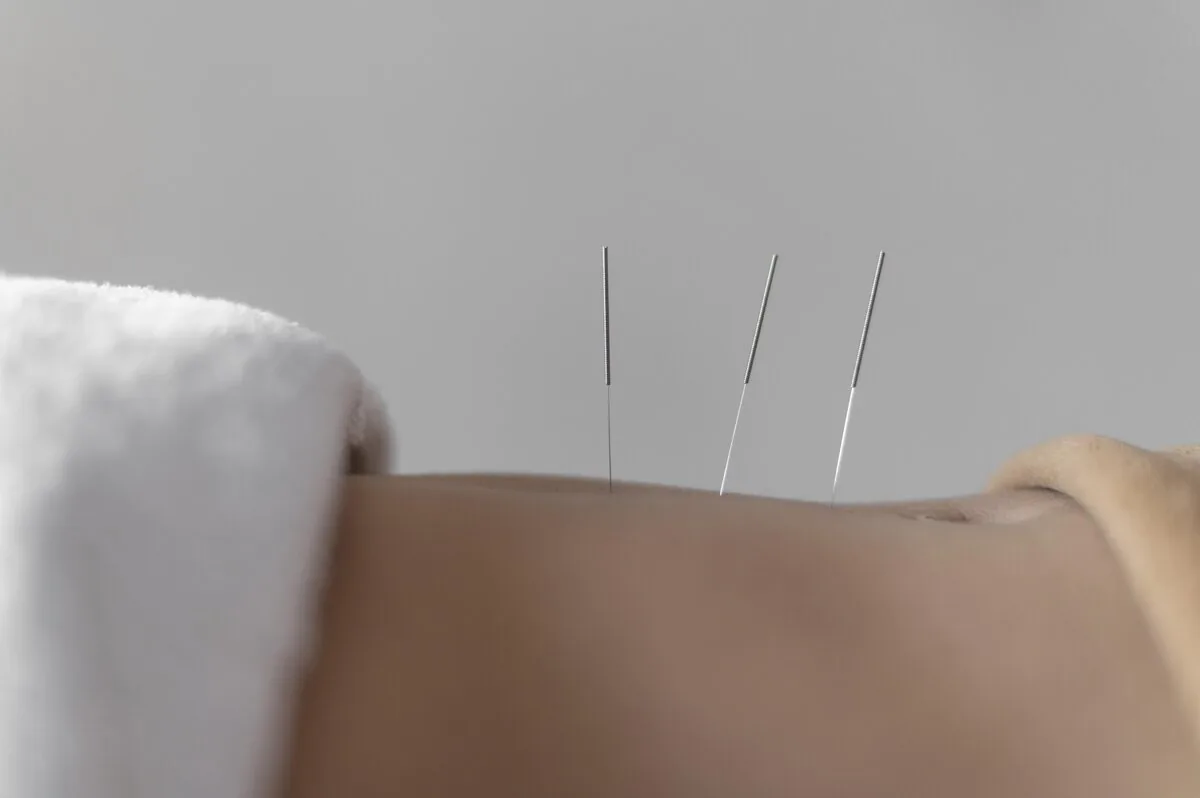
- Same tool
- Sterile single-use filiform needles
- Acupuncture training
- ≈ 2,000–3,000 hours (typical)
- Dry needling training
- Short certification courses (varies)
- Our initial session
- $150 · 60 minutes
— 01
What Dry Needling Is, and How Acupuncture Differs
Dry needling in brief
Dry needling targets myofascial trigger points — those knotted, ropy bands in a muscle that refer pain elsewhere. A clinician, usually a physical therapist, inserts a thin filiform needle directly into the trigger point, often provoking a brief local twitch response as the band releases. "Dry" just distinguishes it from a "wet" injection: no medication is delivered. It is a focused, anatomical technique, typically folded into a broader physical therapy plan with exercise and manual work.
Acupuncture in brief
Acupuncture uses the same class of needle but a different map and a much older framework. A licensed acupuncturist selects points based on a Traditional Chinese Medicine assessment — plus modern anatomy — and treats patterns rather than single spots: the neck pain, yes, and also the sleep, stress, or digestion traveling with it. Sessions usually involve multiple needles retained for 15 to 30 minutes while you rest. Western research suggests the needling may stimulate the nervous system and the release of natural pain-modulating chemicals such as endorphins; the full mechanism is still being studied, and honest practitioners on both sides say so.
Here is the overlap worth knowing: when a physical therapist needles a trigger point and an acupuncturist needles what TCM calls an ashi point, the needle may land in nearly the same tissue. The technique is a cousin. The training, licensing, and scope around it are not — and that is the real difference to understand before booking.
Why does the naming fight get so heated online? Because the two professions grew up separately and now share a tool. Acupuncturists point out that trigger-point needling maps closely onto centuries-old practice; physical therapists point out that their framework is strictly anatomical, with no meridian theory attached. Both are right about their own lane. For you as a patient, the label matters far less than the license, the training hours, and the fit with your specific problem.
— 02
Training & Licensing Differences
This is where the two paths genuinely diverge, and it is the section worth reading twice if you are choosing between providers:
| Dry needling | Acupuncture | |
|---|---|---|
| Technique | Needling of myofascial trigger points for focal muscle pain and movement problems | Needling of points selected from TCM assessment plus modern anatomy; whole-person patterns |
| Typical training | Added to an existing clinical license (usually PT) through certification courses — commonly cited ranges run tens of hours | A graduate degree commonly cited around 2,000 to 3,000 hours, plus national board examinations (NCCAOM) |
| Licensing in Virginia | Performed mostly by physical therapists under the PT board, which requires additional dry needling training | Licensed acupuncturists (L.Ac.) are regulated by the Virginia Board of Medicine; licenses are publicly verifiable |
| Insurance | Usually billed within physical therapy benefits when part of a PT plan | Acupuncture benefits are increasingly common; we accept UnitedHealthcare and Aetna, and Medicare covers acupuncture for chronic low back pain within session limits |
None of this makes one path "better." A physical therapist brings deep rehabilitation training that acupuncturists do not have; a licensed acupuncturist brings needle-specific depth — thousands of supervised hours of it — that a short certification course cannot. The fair question is which toolset your problem needs.
Based on publicly available information, verified 2026-07 — details change; confirm with each clinic.
— 03
Dry Needling or Acupuncture, Which Fits Your Pain?

A practical sorting rule, offered with the usual hedge that individual cases vary:
- Dry needling fits well when the problem is a specific, recent, mechanical one — a knotted trapezius from a hard workout, a calf trigger point flaring mid-training cycle — especially if you are already in physical therapy and want the needling integrated with rehab exercise.
- Acupuncture fits well when pain is chronic, recurring, or traveling with company: the low back pain that returns every deadline season, neck and shoulder tension braided together with poor sleep and stress, or pain you want addressed without adding medications. Research support is strongest for certain chronic pain conditions; a course of 4 to 8 sessions is a reasonable window to judge whether it is helping you.
And a hard line that overrides both options: needles are the wrong first stop for some symptoms. Progressive weakness in a leg or arm, numbness in the groin or saddle area, new bowel or bladder problems, fever with back pain, pain after a fall or accident, or the worst headache of your life — see a doctor now, not an acupuncturist or a physical therapist. Any reputable clinic in McLean will tell you the same and refer you out the door before treating you.
A quick self-sort
- Is the pain new, focal, and clearly mechanical — one spot, one movement? Dry needling within a PT plan is a reasonable first ask.
- Has it lasted more than 3 months, recurred, or spread? Acupuncture's evidence base is strongest here.
- Is pain traveling with poor sleep, stress, or headaches? That cluster favors the whole-person approach.
- Any red-flag symptom above? Physician first. Full stop.
— 04
Can Dry Needling and Acupuncture Be Combined?
Often, yes — and for stubborn musculoskeletal pain, the combination can be sensible. A typical pattern we see around McLean and Tysons: physical therapy twice a week rebuilding strength and mechanics, acupuncture once a week working on the pain pattern, sleep, and the stress load that keeps muscles guarded. The approaches do not conflict; they aim at different layers of the same problem.
Three coordination rules make it work. First, tell each provider about the other — treatment timing and needle sites are easy to coordinate when everyone knows. Second, avoid stacking needle sessions on the same day; give tissue a day or two between them. Third, judge each therapy on its own evidence: keep whichever is earning its slot, drop what is not. Many patients find they taper physical therapy as function returns, then keep occasional acupuncture for maintenance — or the reverse. Both are wins.
We also fold cupping therapy into pain-focused plans here, which pairs naturally with either approach — decompression across a tight upper back complements needle work rather than repeating it.
One practical caution on cost: running two therapies means two bills, and insurance treats them differently — PT visits typically draw from one benefit bucket, acupuncture from another. Before committing to a combined plan, ask both providers for the per-course math and check what each benefit actually covers. Ten minutes of phone calls now beats a surprise statement later. We are happy to do our half of that homework by text.
— 05
Why Patients Choose Licensed Acupuncturists
When the needle itself is the therapy — not an add-on to rehab — depth of needle training becomes the deciding credential. A licensed acupuncturist has spent a graduate program doing little else: point location, needle depth and angle, safety anatomy, sterile technique, and thousands of supervised repetitions before ever practicing independently, then national board certification and Virginia Board of Medicine licensure on top.
That depth shows up in range. Beyond trigger points, an acupuncturist can work on headaches, stress, sleep, digestion, and women's health within the same treatment plan — useful, because chronic pain rarely travels alone. It also shows up in judgment: knowing when not to needle, and when a symptom needs a physician first.
Verification is easy and worth the two minutes whoever you choose: look up an acupuncturist on the Virginia Department of Health Professions license search, or ask a physical therapy clinic what dry needling training their PTs completed beyond the base license. Reputable providers volunteer this before you ask. Treat hesitation on either question as your answer.
At Harmony Acupuncture & Wellness Spa in McLean, every needle is placed by a licensed practitioner with 15+ years of practice — never a technician, never a weekend certificate. Sessions are unhurried: 60 minutes for the $150 initial visit, 30-minute follow-ups at $100, packages at $80 a visit, published on our pricing page. We are on Chain Bridge Rd (Route 123), open 7 days from 9 AM to 9 PM, with free parking at the door. If you are still weighing options, our guide to choosing an acupuncture clinic in McLean & Tysons names every local practice and the questions worth asking each one.
— Pricing
| Acupuncture | Price |
|---|---|
| Initial session · 60 minutes | $150 |
| Follow-up session · 30 minutes | $100 |
| Package · 5 sessions (30 minutes each)($80 per visit) | $400 |
Insurance patients: sessions are billed through your plan — text us your policy info for a free benefits check.
Parking & arrival
Free parking — easy in, easy out on Chain Bridge Rd
Open every day 9 AM – 9 PM — lunch-break, after-work, and weekend visits all fit.
- Park free directly on-site at 1481 Chain Bridge Rd, Ste 300 — no garages, no meters.
- Look for the red-brick building; we're in Ste 300 with signage at the entrance.
- Arrive 10 minutes early for your first visit to settle in — WiFi and a snack bar are waiting.
— Questions
Asked & answered.
Does dry needling hurt more than acupuncture?
Is dry needling the same as acupuncture?
Does insurance cover acupuncture or dry needling?
How many acupuncture sessions will I need for pain?
Can I do physical therapy and acupuncture at the same time?
— Research & references
NCCIH — Chronic Pain and Complementary Health Approaches
The NIH's evidence review suggests acupuncture may help several chronic pain conditions, with benefits typically assessed over a course of care.
NCCIH — Traditional Chinese Medicine: What You Need To Know
Background on acupuncture's TCM framework and safety profile when performed by trained practitioners with sterile needles.
Citations are summarized — please consult the original sources. This page is general health education, not medical advice for your specific case; results vary and acupuncture works best alongside, not instead of, care from your physician.
— Keep exploring
Condition
Acupuncture for Back Pain
Where the research for acupuncture is strongest.
Condition
Neck & Shoulder Pain
Tech neck, desk tension, and how needling may help.
Compare
Best Acupuncture in McLean & Tysons
Every local clinic named, with the questions to ask.
Guide
New Patients & First Visit
What a 60-minute acupuncture intake actually involves.