— Conditions · Knee Pain & Osteoarthritis
Acupuncture for Knee Pain & Stiff Mornings
Stairs you once took two at a time. A first walk of the day that needs a few steps to loosen. Here is what acupuncture can — and cannot — do for chronic knee pain and knee osteoarthritis, with the research stated plainly.
Quick answer
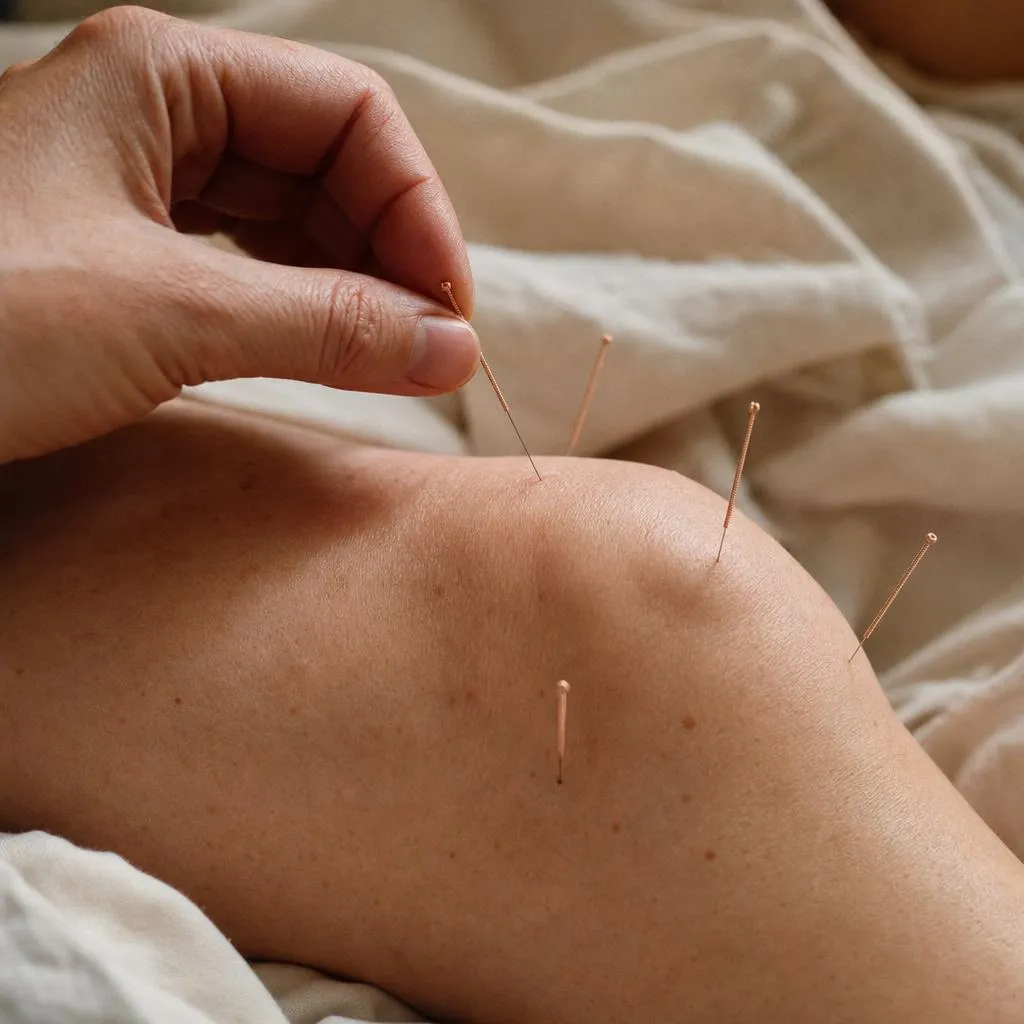
Acupuncture for knee pain is a drug-free treatment in which a licensed practitioner places thin, single-use sterile needles around the knee and along the leg to help ease the ache and stiffness of chronic knee pain and knee osteoarthritis, starting with a first visit of 60 minutes for $150. At Harmony Acupuncture & Wellness Spa, 1481 Chain Bridge Rd, Ste 300 in McLean, VA, follow-ups are 30 minutes for $100 and a package of 5 sessions is $400 — $80 per visit. We are open 7 days, 9 AM to 9 PM, with free parking at the door. The American College of Rheumatology conditionally recommends acupuncture for knee osteoarthritis, but measured effects are modest and vary from person to person.
- Initial visit
- $150 · 60 minutes
- Follow-up
- $100 · 30 minutes
- Package
- 5 sessions · $400
- 2026 arthritis guideline
- Conditionally recommended
— 01
What Chronic Knee Pain usually turns out to be
In middle-aged and older adults, long-running knee pain very often turns out to be osteoarthritis: a slow change in which the cartilage cushioning the ends of the thigh and shin bones thins, the bone beneath it remodels, and the joint lining can become irritated. The result is an ache that builds with use, stiffness after rest, and knees that object to stairs.
How knee osteoarthritis tends to behave
Osteoarthritis of the knee has a recognisable rhythm. Stiffness after sleep or a long sit that loosens within minutes of moving. An ache that grows across a day on your feet, or after a rocky afternoon hike at Great Falls Park. Stairs, especially going down, and getting up from a low sofa. Sometimes a grinding or crackling feeling under the kneecap. Flares that come and go with activity and, many people swear, with the weather.
Stiffness that lasts for hours, or knees that turn hot and visibly swollen alongside other joints, does not fit that rhythm. Those features can point to an inflammatory arthritis such as rheumatoid arthritis or gout, which a physician or rheumatologist needs to diagnose and treat.
Pain at the front of the knee
Not every sore knee is arthritic. An ache around or behind the kneecap that flares on stairs, in squats, or after a long film with bent knees is often patellofemoral pain, and it turns up in desk workers and weekend walkers as well as runners. If your trouble started with running, a sport or a sudden twist, our page on knee pain from running and sports injuries covers runner's knee, iliotibial (IT) band pain and the return-to-training side. This page stays with the slower, chronic kind.
Red flags — see a physician first
Some knee symptoms need a medical examination before acupuncture or any other conservative care. Contact a physician promptly, or go to urgent care, if you have:
- A hot, red, swollen knee, especially with fever or chills — a joint infection or gout attack needs ruling out
- A knee you cannot put weight on, or one that looks misshapen, after a fall or twist
- A knee that locks, catches, or gives way under you
- Pain, swelling or warmth in the calf of the same leg — a blood clot needs ruling out urgently
- Severe pain even at rest, or a knee you can no longer fully bend or straighten
- Pain that is no better after three days of rest, ice and over-the-counter care
Once those are ruled out — and with diagnosis, imaging and medication decisions left with your physician — chronic knee pain is a reasonable place for conservative care to begin.
— 02
How Acupuncture for Knee Pain may work
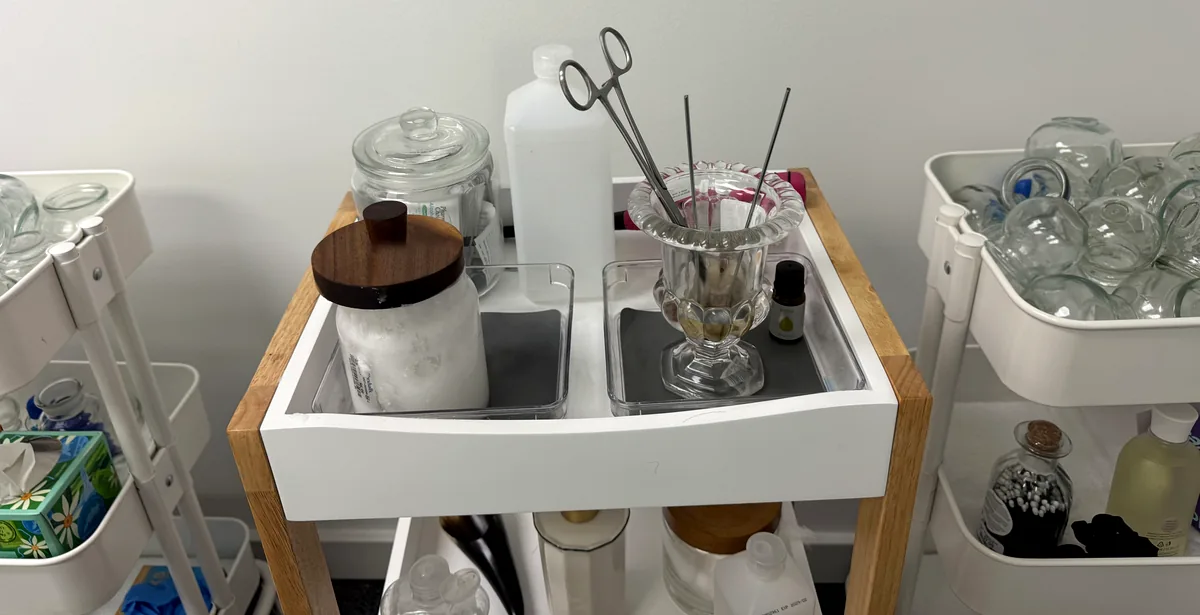
Acupuncture for knee pain combines needles placed close to the joint with points further down the leg, chosen to fit where the pain sits and what makes it worse. Two traditions explain the same session in very different language, and neither one claims that needles rebuild cartilage.
The Traditional Chinese Medicine view
Traditional Chinese Medicine (TCM) groups aching, stiff joints under bi syndrome, usually translated as "painful obstruction": wind, cold or damp lodged in the channels so that qi and blood stop moving freely through the joint. Knees that hurt more in cold, wet weather fit the classic damp-cold picture. Classical point selection follows that thinking — the two hollows either side of the tendon below the kneecap, traditionally called the "knee eyes", plus points on the shin and outer leg such as ST36 (Stomach 36) and GB34 (Gallbladder 34), which have been used for leg and knee complaints for centuries.
The physiological view
Research offers a different vocabulary. Fine needles stimulate sensory nerves in skin and muscle, and studies suggest this may change how pain signals are processed in the spinal cord and brain, including through the body's own pain-dampening chemicals. Easing the thigh and calf muscles that brace around a sore knee may matter too, because guarded muscle changes how the joint takes load. None of these mechanisms alters an X-ray. Whatever acupuncture does for an arthritic knee appears to act on pain and function, not on structure.
What a knee session is like
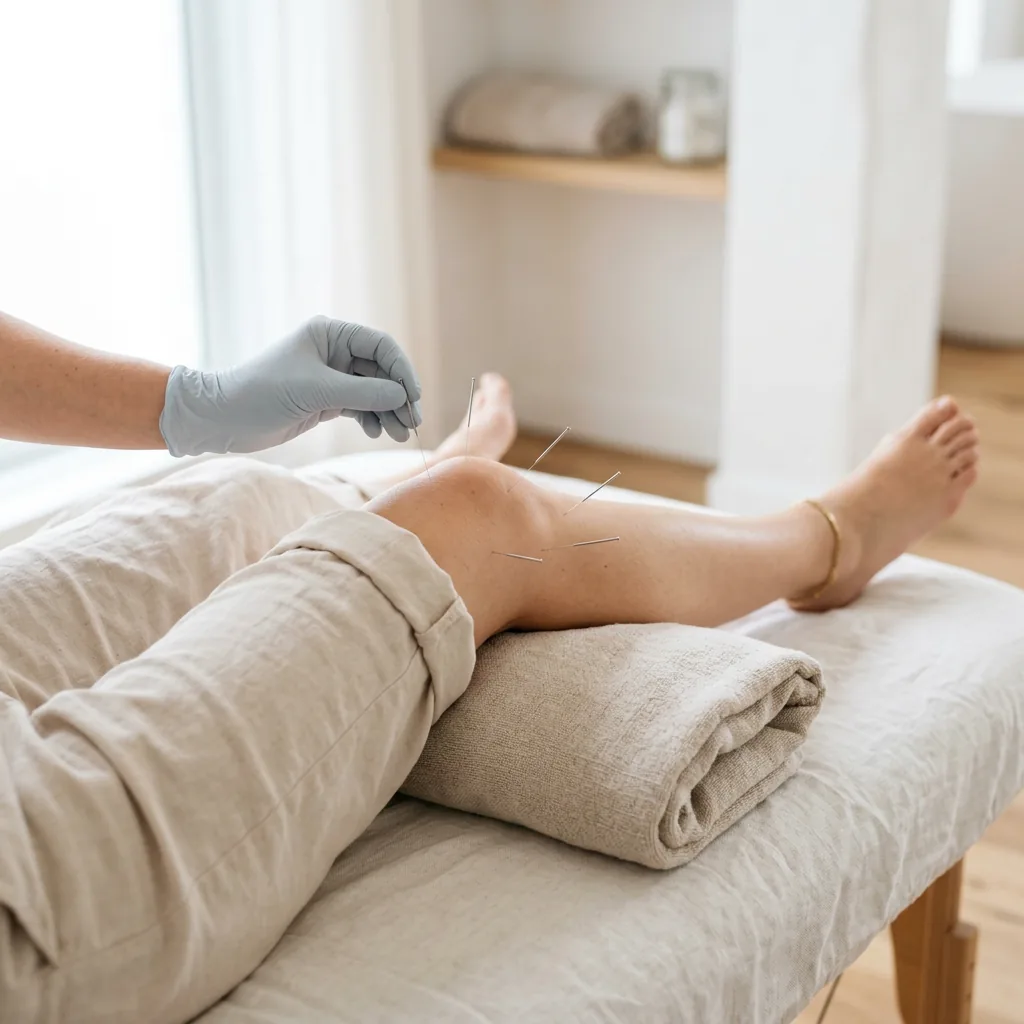
Knee treatments are commonly done lying on your back, often with a support under the knee so it can rest slightly bent, with single-use sterile needles placed around the joint and down the leg while you rest in a private room. Loose trousers that push up past the knee, or a pair of shorts, save any wardrobe negotiation. Most people feel a brief prick, then a dull heaviness or warmth around a point; if a needle ever feels sharp, say so and it is adjusted. New to acupuncture? The new patient guide explains what the first 60 minutes includes.
— 03
What Research Shows — and its limits
Most of the acupuncture studies that show benefit for arthritis were done in knee osteoarthritis, and the honest summary of them is modest. In a 2018 review described by the National Center for Complementary and Integrative Health (NCCIH), acupuncture beat no treatment across 10 studies with 2,413 participants and beat sham acupuncture across 9 studies with 2,376 participants — but the margin over sham was the smaller of the two.
NCCIH adds that the pain relief in that analysis was comparable to that of nonsteroidal anti-inflammatory drugs (NSAIDs) such as ibuprofen, and that a separate analysis of 20 studies with 6,376 participants, osteoarthritis among the conditions, found benefits persisting a year after treatment ended. Other findings pull the other way. A 2014 Australian trial found needle and laser acupuncture only modestly better than no treatment for knee pain from osteoarthritis, and no better than sham laser. NCCIH's current summary for clinicians puts it this way: acupuncture appears to be more than a placebo, but the differences are relatively modest, and in chronic arthritic knee pain the pain relief may be short-term even where function improves.
Where the 2026 guideline lands
In September 2026 the American College of Rheumatology (ACR) posted a summary of its update to the 2019 osteoarthritis guideline it wrote with the Arthritis Foundation; the full paper is still to be published. The summary keeps acupuncture as a conditional recommendation for knee, hip and hand osteoarthritis, with moderate certainty of evidence for the knee. A conditional recommendation is a weaker grade than a strong one, and the ACR frames these choices as shared decisions between patient and clinician.
| Non-drug option | ACR 2026 recommendation | Certainty of evidence |
|---|---|---|
| Exercise | Strongly recommended | Moderate |
| Weight loss, if overweight or obese | Strongly recommended | Moderate |
| Acupuncture | Conditionally recommended | Moderate for knee and hip |
| Knee braces | Conditionally recommended | Very low to moderate, by brace type |
| Locally applied heat or cold | Conditionally recommended | Low |
| Massage therapy | Conditionally recommended | Low |
| Tai chi | Conditionally recommended | Very low |
| Wedged shoe insoles | Conditionally recommended against | Very low |
Read the table from the top and the message is clear: exercise and, where it applies, weight loss carry the strongest grades. Acupuncture is one of several reasonable supporting options, not the centrepiece.
What acupuncture cannot do for a knee
Needling does not regrow cartilage, straighten a bowed knee, repair a torn meniscus, or change what your next X-ray shows. It will not substitute for the strengthening work that lets the thigh muscles absorb load, and it is no reason to postpone a conversation with an orthopedic surgeon if your knee is failing you day to day. Some people notice clear relief, some notice a little, and some notice nothing; a defined, time-limited trial is how you find out which group you are in.
— 04
A Realistic Knee Pain Plan built around exercise
A realistic knee pain plan puts the strongly recommended work first and lets acupuncture support it. For most people that means a physical therapist or physician setting a strengthening and walking program, weight management where it applies, and needling used to take the edge off pain so the program is easier to keep doing.
- First visit — 60 minutes, $150. Bring any diagnosis, imaging report and medication list, and come ready to describe which movements hurt and when. The consultation and a first treatment happen in the same hour.
- Set a baseline you can measure. Pick two or three everyday markers — minutes of walking on the Washington & Old Dominion (W&OD) Trail before the ache starts, whether you need the handrail on stairs, how long the knee takes to loosen in the morning — and write them down before treatment begins.
- Run a defined trial. Follow-ups are 30 minutes for $100. The package of 5 sessions ($400, or $80 per visit) is a natural size for a first trial.
- Reassess honestly. Compare your markers with the baseline at the end of the trial. If they have moved, sessions can be spaced further apart; if nothing has changed, we will say so rather than suggest more of the same.
- Keep the exercise going. Whatever the needles do, the strengthening program is what the guideline grades highest, so it continues throughout.
Pairing acupuncture with massage
The ACR's 2026 summary also moved massage therapy to a conditional recommendation for knee and hip osteoarthritis, a change of direction from 2019, though on low-certainty evidence. If hands-on work suits you better than needles, or alongside them, a 60 minute tui na massage can concentrate on tight quadriceps, hamstrings and calves for $100 — or $80 at the member rate, which applies once you buy a package of 5 or more massage sessions, with no fee and no signup.
Small habits that tend to help
Many people find several short walks easier on an arthritic knee than one long outing. A heating pad before activity and a cold pack after a flare cost almost nothing, and the ACR summary conditionally recommends locally applied heat or cold. Supportive, cushioned shoes, a firm cushion that raises a low sofa seat, and a handrail within reach all trim the daily load. If walking is limited, the summary lists a cane or other mobility aid as good practice. None of it is dramatic; together, it reduces how many hard moments the knee has in a week.
— 05
Cost, Insurance & Medicare for knee care
Acupuncture at Harmony costs the same whatever the condition: the first visit is 60 minutes for $150, follow-up sessions are 30 minutes for $100, and a package of 5 sessions is $400, which works out to $80 per visit. Every rate is published on our pricing page, and the acupuncture price table appears below.
Commercial insurance
We accept UnitedHealthcare and Aetna for acupuncture; massage is self-pay. Coverage for knee pain depends on your specific plan, so text your policy information to 240-715-5939 for a free benefits check before your first visit. Our insurance page has the details.
Does Medicare cover acupuncture for knee pain?
No. Medicare covers acupuncture only for chronic low back pain, under specific conditions laid out on our back pain page. Knee osteoarthritis is not covered under that benefit. If you are unsure what your own plan includes, text us the details and we will check rather than guess.
Getting here
The clinic is at 1481 Chain Bridge Rd, Ste 300, with free parking at the door, and we are open 9 AM to 9 PM every day — so a session can follow a morning walk or close out a workday. Directions and everything else about the clinic are on our acupuncture in McLean, VA page. If your heels hurt with the first steps of the morning too, see acupuncture for plantar fasciitis.
— Pricing
| Acupuncture | Price |
|---|---|
| Initial session · 60 minutes | $150 |
| Follow-up session · 30 minutes | $100 |
| Package · 5 sessions (30 minutes each)($80 per visit) | $400 |
Insurance patients: sessions are billed through your plan — text us your policy info for a free benefits check.
Parking & arrival
Free parking — easy in, easy out on Chain Bridge Rd
Open every day 9 AM – 9 PM — lunch-break, after-work, and weekend visits all fit.
- Park free directly on-site at 1481 Chain Bridge Rd, Ste 300 — no garages, no meters.
- Look for the red-brick building; we're in Ste 300 with signage at the entrance.
- Arrive 10 minutes early for your first visit to settle in — WiFi and a snack bar are waiting.
— Questions
Asked & answered.
Can acupuncture help bone-on-bone knee arthritis?
It cannot rebuild cartilage, so an X-ray will look the same afterwards. Some people with advanced osteoarthritis use it for pain and stiffness while they work on strength, manage weight, or decide about surgery — an earlier ACR guideline specifically suggested it for people who were candidates for a knee replacement but could not or would not have one. Whether and when to replace the joint is a decision for you and your orthopedic surgeon.
Should I choose acupuncture or a cortisone injection for knee osteoarthritis?
They are different tools, and one does not rule out the other. The ACR's 2026 summary strongly recommends steroid injections into the knee for osteoarthritis and conditionally recommends acupuncture, so injections carry the stronger grade. Timing and frequency of injections are your physician's call; acupuncture is a needle-only option with relatively few reported complications that some people use alongside or between injections. Talk it through with your physician — we are glad to coordinate.
How will I know whether acupuncture is helping my knee?
Use numbers from your own week rather than memory. Before the first session, note how many minutes you can walk before the ache starts, whether you need the handrail on stairs, and how long morning stiffness lasts. Check the same markers at the end of the 5 session package. If they have moved, keep going and space visits out; if they have not, that is a clear answer too, and we will say so.
Can I have acupuncture after a knee replacement or knee surgery?
Not on a recently operated knee without your surgeon's clearance. Once your surgeon is comfortable, treatment elsewhere on the leg and body may help with the muscle tension and compensation patterns that rehab tends to uncover. Tell us about any implant, recent surgery, blood thinner or bleeding disorder when you book, and keep your physical therapist's program as the priority — needles support rehab, they do not replace it.
Does insurance or Medicare cover acupuncture for knee pain?
Commercial plans sometimes do. We accept UnitedHealthcare and Aetna for acupuncture, and coverage varies by plan, so text your policy details to 240-715-5939 for a free benefits check. Medicare is different: it covers acupuncture only for chronic low back pain, so knee osteoarthritis is not covered under that benefit. Self-pay rates are on our pricing page.
Should I keep walking if my knee aches?
Generally, yes. Exercise carries the strongest recommendation in the ACR's osteoarthritis guidance, and resting an arthritic knee completely can leave the muscles around it weaker. The practical questions are how much and what kind, which a physician or physical therapist can tailor to you. Sharp pain, a knee that swells noticeably after activity, or one that locks or gives way is a reason to stop and get it checked.
— Research & references
NCCIH — Acupuncture: Effectiveness and Safety
Reports a 2018 review in which acupuncture outperformed both no treatment and sham for osteoarthritis pain, with a smaller margin over sham.
NCCIH — Arthritis and Complementary Health Approaches: What the Science Says
Concludes acupuncture appears to be more than a placebo for knee osteoarthritis, though its effects are relatively modest and pain relief may be short-term.
American College of Rheumatology — Osteoarthritis Guideline (2026 update)
The 2026 summary conditionally recommends acupuncture for knee, hip and hand osteoarthritis and strongly recommends exercise and, where appropriate, weight loss.
MedlinePlus — Knee Pain
Lists common causes of knee pain and the warning signs — such as being unable to bear weight, locking, fever or calf symptoms — that call for a medical visit.
Citations are summarized — please consult the original sources. This page is general health education, not medical advice for your specific case; results vary and acupuncture works best alongside, not instead of, care from your physician.
— Keep exploring
Condition
Sports Injuries & Recovery
Runner's knee, IT band pain and other overuse injuries in active people.
Condition
Plantar Fasciitis
Heel pain with the first steps of the morning — the evidence, honestly.
Service
Tui Na Massage
Hands-on work for the thigh and calf muscles around a sore knee.
Location
Acupuncture in McLean, VA
Chain Bridge Rd clinic — free parking, open 7 days, 9 AM to 9 PM.