— Swelling & Fluid Retention · McLean, VA
Lymphatic Drainage for Swelling & Heavy Legs.
Puffy ankles after a red-eye into Dulles, heavy legs at the end of a Beltway commute, rings that stop fitting in a humid DC August. Light, slow, unhurried bodywork on Chain Bridge Rd in McLean, for the everyday kind of fluid retention.
Quick answer
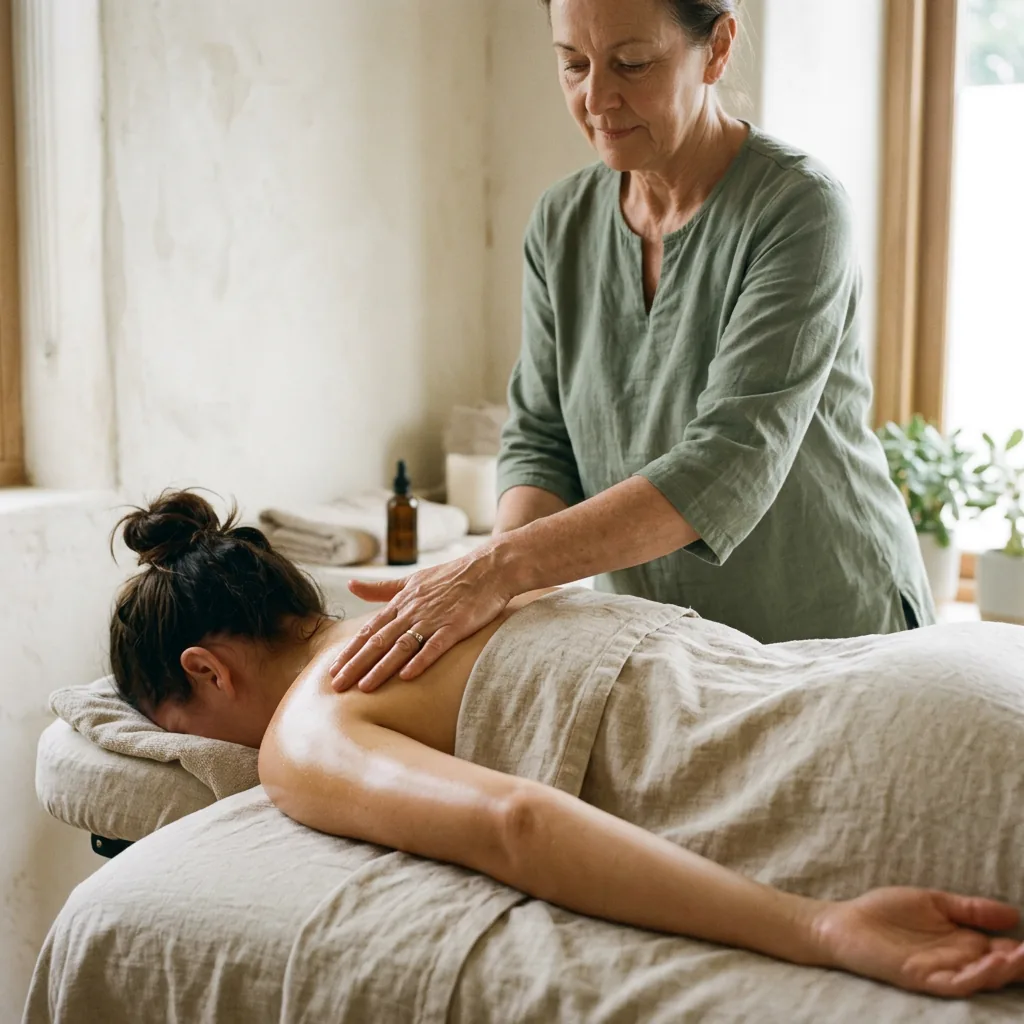
Lymphatic drainage massage is a very light, slow, rhythmic form of bodywork that follows the direction of the lymphatic vessels to help the body move fluid, protein and immune cells out of tissue that feels puffy or heavy — a session runs 60 minutes and costs $120, or $100 for members. At Harmony Acupuncture & Wellness Spa, 1481 Chain Bridge Rd, Ste 300, McLean, VA 22101, sessions are available 7 days a week, 9 AM to 9 PM, with free parking on site and care in English and Mandarin Chinese. This is a comfort and wellness service, not medical treatment: diagnosed lymphedema needs a certified lymphedema therapist and Complete Decongestive Therapy, which we do not provide, and any new, one-sided, painful or rapidly worsening swelling should be evaluated by a physician before you book anything. Questions first? Call or text 240-715-5939.
- Session
- $120 · 60 minutes
- Member rate
- $100 · package of 5+
- Pressure
- Very light, slow, directional
- Hours
- 7 days · 9 AM – 9 PM
— 01
Why Fluid Pools in the first place.
Blood has a pump. Lymph does not. Your heart pushes blood through the arteries with every beat, but the lymphatic system — the parallel network of thin vessels and small nodes that carries water, protein and immune cells back toward the bloodstream — has no pump of its own. It moves because you move. Every calf contraction squeezes the deep vessels of the leg. Every full breath drops the diaphragm and creates the pressure change that helps draw fluid up through the chest, where it rejoins circulation near the collarbone. Every arm swing on a walk contributes. Sit still for nine hours and the system does very little — which is the entire, unglamorous explanation for why your ankles look different at 6 PM than they did at 7 AM.
Fluid settles where gravity puts it and where movement is missing: usually the feet, ankles and lower legs, sometimes the hands and fingers, sometimes the face after a salty dinner. The tissue feels tight and faintly heavy, shoes fit differently, a sock leaves a line across the ankle. For most healthy people that is ordinary, temporary fluid retention which settles overnight. It is also, occasionally, the way a real medical problem announces itself — which is why an entire section below is devoted to what should send you to a physician before you book any kind of bodywork.
What a Northern Virginia week does to your legs
The pattern we hear on Chain Bridge Rd is boringly consistent. A long-haul flight out of Dulles — eight or twelve hours in a pressurized cabin with knees bent and ankles motionless — and the legs are reliably worse on the return leg than the outbound. A 6:40 AM shuttle out of Reagan for a same-day meeting in Boston or Atlanta, back that night, two flights and almost no walking in between. Then the commute itself: forty minutes inbound on the Beltway, forty back, bracketing eight hours in a chair in a Tysons tower. Consultants, federal staff, contractors and attorneys in this area routinely stack all three into a single week.
Then add the climate. A DC-area July is genuinely humid, and heat widens the small vessels near the skin, which allows more fluid to move out into the surrounding tissue. Hands puff on a Saturday walk along the Potomac. Ankles thicken by mid-afternoon even in air conditioning. People who stand a full shift — retail staff in Tysons Corner Center, teachers, nurses, stylists, restaurant crews — get the mirror-image version of the problem: not too little movement, but long static standing, which loads the veins of the leg without ever really pumping them. And many women notice a predictable, cyclical version of all of this tied to normal hormonal fluctuation across the month. None of that is unusual, and none of it means anything is wrong. It simply means the system that clears fluid is under-worked, and a slow hour of lymphatic drainage massage is one pleasant way to give it some help.
— 02
What an Hour of Lymphatic Drainage actually involves.
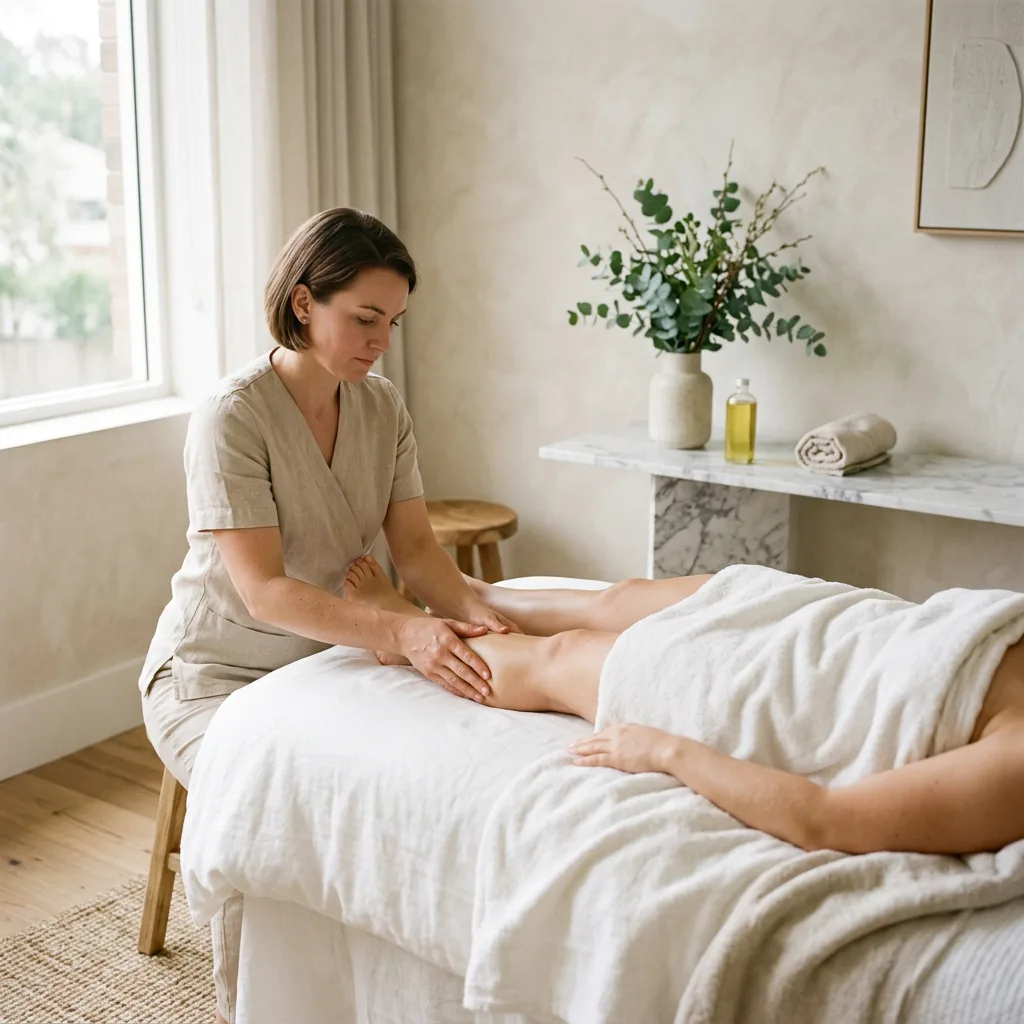
The first thing nearly everyone notices about lymphatic drainage is how light it is. If your reference point is a deep tissue hour or our tui na massage, set that expectation aside completely. The superficial lymphatic vessels sit just beneath the skin — a matter of millimetres — so the pressure that encourages them is closer to the weight of a resting hand than to anything you would normally call a massage grip. Press hard and you simply compress the vessels you were hoping to help. Light, slow, rhythmic and directional is the entire technique, and the slowness is not padding: the vessels have their own unhurried rhythm, and the work is paced to it.
How the 60 minutes usually go
- A short intake. Your practitioner asks what is swelling, when it started, whether it is one side or both, what your doctor has said, and what medications or conditions are in the picture. If anything in your answers belongs with a physician first, we will tell you plainly and reschedule.
- Neck and collarbone first. This surprises people who came in about their ankles. Lymph from the whole body eventually drains near the collarbone, so the work opens that end of the route before anything downstream is asked to move.
- Trunk and abdomen, if appropriate. Slow, broad, gentle contact, coordinated with your breathing.
- Limbs, upper segment before lower. The thigh is cleared before the calf, the calf before the foot — the same logic as unclogging a drain from the top down rather than pushing from the bottom.
- A quiet finish. Most people are extremely relaxed by the end; a fair number fall asleep. You will be offered water and given a couple of things to do at home.
Sessions run 60 minutes at $120, or $100 once you are a member — and membership at Harmony is automatic when you buy a package of 5 or more massage sessions, with no fee and no signup form. Every session is performed by licensed practitioners in a practice with more than 15 years of experience and over 5,000 clients served. Full details sit on our pricing page, and if this is your first visit, our new patients page covers arrival, what to wear and how the intake works.
Being honest about the evidence
We would rather set expectations correctly than oversell an hour of bodywork. Manual lymphatic drainage has been studied most seriously in clinical settings — supervised post-surgical care and specialist management of diagnosed conditions — and even there the findings are mixed and the trials are often small. For ordinary, everyday fluid retention in otherwise healthy people, the published research is genuinely limited. What we can say honestly is that many clients describe their legs as lighter and less tight afterwards, that the hour itself is deeply calming, and that the effect people report is temporary rather than a fix. Anyone promising you a permanent result or a fixed timeline is telling you something the evidence does not support. Gentle massage in general is well tolerated and, as the National Center for Complementary and Integrative Health notes, appears to be low-risk when performed by a trained practitioner on appropriate candidates.
— 03
Everyday Triggers, Self-Care & where lymphatic drainage fits.
Most of the swelling we hear about traces back to a short, recognisable list of everyday triggers. The table below pairs each with self-care that is low-risk and widely suggested — none of it is a treatment, none of it is a substitute for a physician's advice, and if your swelling is new, one-sided or painful, skip straight to the next section.
| Everyday trigger | What tends to happen | Practical self-care |
|---|---|---|
| Long-haul flight out of Dulles | Hours of bent knees and motionless ankles often leave feet and lower legs feeling tight, sometimes for a day or two afterwards | Many travellers find it helps to walk the aisle every hour or so, do slow ankle circles and calf pumps in the seat, and keep drinking water; graduated compression socks may be worth asking your physician about if you fly often |
| Desk day plus a Beltway commute | Eight seated hours bracketed by two seated drives tends to leave the calf muscle pump essentially idle all day | A short walk every hour may help more than one long walk at the end; some people find raising the feet for ten or fifteen minutes in the evening takes the edge off |
| A full standing shift | Long static standing can load the leg veins without ever really pumping them, and many people notice it most in the last hours of the shift | Shifting weight, rising onto the toes periodically and taking short seated breaks are commonly suggested; supportive footwear often makes a noticeable difference |
| A salty meal or a week of restaurant dinners | Higher sodium intake is often followed by temporary puffiness, frequently most obvious in the face and fingers the next morning | Many people find it settles on its own within a day; steady water intake and more ordinary meals for a couple of days are the usual, low-risk approach |
| DC summer heat and humidity | Heat widens small vessels near the skin, which may allow more fluid into surrounding tissue — hands and ankles often feel fullest on humid afternoons | Cooler indoor time, elevation and staying hydrated may all help; a cool (not ice-cold) rinse of the lower legs is something plenty of clients say they like |
| Hormonal fluctuation across the cycle | Many women notice a predictable, cyclical pattern of puffiness that tends to resolve on its own | Tracking the pattern can be reassuring, and gentle movement often helps; if the swelling is severe, new or worsening, it is worth raising with your OB-GYN or primary care physician |
Where a session fits into that list
Realistically, lymphatic drainage massage is a complement to the habits above rather than a replacement for them. The clients who feel they get the most from it tend to be the ones who also walk, elevate and hydrate — the hour on the table is the deliberate, unhurried version of what movement does all day. Booking one after a long trip home into Dulles, or at the end of a heavy travel month, is a common pattern here. So is pairing it with a regular tui na massage for the tension side of a desk job, since the two do genuinely different things at genuinely different pressures.
— 04
When Swelling Needs a Doctor first.
This is the most important section on this page, and we would rather you read it than book. Swelling is a symptom, and some of the conditions behind it are serious and time-sensitive. Massage of any kind can be the wrong move — occasionally a dangerous one — when swelling has a medical cause. Please see a physician, urgent care or an emergency department before booking any bodywork if any of the following apply.
- Swelling in only one leg, ankle or arm — one-sided swelling, particularly with calf pain, tenderness, warmth or a change in skin colour, can indicate a blood clot (deep vein thrombosis). This needs same-day medical assessment, not massage.
- Swelling with chest pain or shortness of breath — treat this as an emergency and seek care immediately.
- Sudden swelling, or swelling that is rapidly getting worse — a fast change deserves prompt evaluation rather than a wait-and-see approach.
- Swelling with redness, heat, or fever — these can point to infection such as cellulitis, which needs medical treatment; massaging an infected area may spread it.
- Swelling with a known heart, liver or kidney condition — including congestive heart failure and kidney failure. New or increased swelling can signal a change in your condition, and your physician should be the one to interpret it.
- Swelling during pregnancy accompanied by headache, vision changes, or upper abdominal pain — contact your obstetric provider right away. Ordinary ankle puffiness is common in pregnancy; that particular combination is not, and it is checked urgently for a reason.
Diagnosed lymphedema is a different service
We want to be unambiguous about this. If you have been diagnosed with lymphedema — after lymph node removal, radiation, or from a primary cause — the appropriate care is Complete Decongestive Therapy delivered by a certified lymphedema therapist: specialised manual technique, multi-layer compression bandaging, prescribed compression garments, exercise and skin care, with ongoing clinical oversight. That is a credentialed medical specialty and it is not what we offer. Our practitioners are licensed massage practitioners providing a wellness service for everyday fluid retention, and we will say so honestly and refer you onward rather than take the booking. Your physician or oncology team can refer you to a certified therapist, and hospital systems across Northern Virginia and the District run dedicated programs.
When we will ask you to reschedule
Even for ordinary swelling, there are conditions under which we will not perform lymphatic drainage massage and will ask you to see your physician first:
- Active infection or cellulitis, anywhere on the body
- A known or suspected blood clot
- Congestive heart failure
- Kidney failure
- Active, untreated cancer without clearance from your oncologist
- Fever
If you are recovering from a procedure and have surgical clearance, that is a different conversation — see our page on post-surgery lymphatic drainage, which covers timing, clearance and what your surgeon will want to know. If you are pregnant, please read our pregnancy page and speak to your obstetric provider before booking any bodywork. Telling us the full picture is never an inconvenience; it is what lets us do this safely.
— 05
Between Sessions & booking lymphatic drainage in McLean.
What you do in the days around a session matters more than the session itself, and none of it is complicated. Assuming a physician has cleared you and your swelling is the everyday kind, the following are widely suggested, low-risk habits — not treatments, and not promises.
- Walk. The calf is the closest thing the lower body has to a pump. Short, frequent walks tend to do more than one long one — a lap of the office floor each hour, a loop around the block after dinner, the long way from the parking deck.
- Calf pumps. Sitting or lying down, flex and point the ankles slowly, twenty or thirty times, several times a day. Easy to do at a desk, on a plane, or in a Beltway traffic jam while parked.
- Elevate. Feet above hip level for ten to twenty minutes in the evening — legs up the wall, or a couple of pillows under the ankles — is something many people find takes the heaviness out.
- Hydrate steadily. Drinking less water does not reduce fluid retention; steady, ordinary hydration across the day is the sensible approach, especially through a humid Virginia summer.
- Compression, only if your physician advised it. Graduated compression socks or stockings help some people considerably, but they are not right for everyone and the wrong grade can cause problems. Ask your doctor rather than guessing at the pharmacy.
- Breathe deeply. Slow diaphragmatic breathing is part of what moves lymph through the chest, and it costs nothing. A few minutes before bed is plenty.
After a session, most people are asked to keep the rest of the day light: water, a gentle walk rather than a hard workout, and skipping the hot tub or sauna that evening. It is common to visit the bathroom more than usual for the next several hours. If anything feels off — new pain, redness, or swelling that increases rather than settles — stop and contact your physician.
Booking on Chain Bridge Rd
Harmony Acupuncture & Wellness Spa is at 1481 Chain Bridge Rd, Ste 300, McLean, VA 22101, with free parking on site — a few minutes from downtown McLean, roughly ten from Tysons, and an easy run in from Arlington, Falls Church, Vienna or Great Falls. We are open 7 days a week, 9 AM to 9 PM, which is deliberately wide: a lymphatic drainage session fits before work, at lunch, or on a Sunday evening after a weekend of flights. Care is available in English and in Mandarin Chinese.
Lymphatic drainage massage is $120 for 60 minutes, or $100 for members — and membership happens automatically when you purchase a package of 5 or more massage sessions, with no fee and no separate signup. Compare it against everything else on our pricing page, read the fuller lymphatic drainage service page for how the technique is used across our practice, or see what else we offer in McLean. To ask a question before you commit, call or text 240-715-5939 — including the question of whether this is the right service for you at all. If it is not, we will say so.
— Pricing
| Massage Therapy | Price | Member |
|---|---|---|
| Meridian massage · 60 minutes | $100 | $80 |
| Deep tissue massage · 60 minutes | $100 | $80 |
| Prenatal massage · 60 minutes | $100 | $80 |
| Postnatal massage · 60 minutes | $100 | $80 |
| Lymphatic drainage massage · 60 minutes | $120 | $100 |
Membership is automatic when you purchase a package of 5 or more massage sessions — no fee, no signup. Member rates are shown in the right-hand column.
Membership
Purchase a package of 5 or more massage therapy sessions and you're automatically a member — no separate signup, no fee.
- Massage at the member rate of $80 / 60 minutes
- Lymphatic drainage at the member rate of $100 / 60 minutes
- Free cupping therapy add-on
- Free gua sha therapy add-on
- Free hot stone therapy add-on
Parking & arrival
Free parking — easy in, easy out on Chain Bridge Rd
Open every day 9 AM – 9 PM — lunch-break, after-work, and weekend visits all fit.
- Park free directly on-site at 1481 Chain Bridge Rd, Ste 300 — no garages, no meters.
- Look for the red-brick building; we're in Ste 300 with signage at the entrance.
- Arrive 10 minutes early for your first visit to settle in — WiFi and a snack bar are waiting.
— Questions
Asked & answered.
How much does lymphatic drainage massage cost in McLean?
What does lymphatic drainage feel like?
How often should I book a session?
Will lymphatic drainage help my puffy ankles?
Is lymphatic drainage safe during pregnancy?
What should I do after a session?
— Research & references
NCCIH — Massage Therapy: What You Need To Know
NCCIH describes massage therapy as generally low-risk when performed by a trained practitioner on appropriate candidates, while noting that evidence for many specific uses remains limited.
NCCIH — Massage Therapy for Health: Research Digest
This research summary suggests massage may help with pain and stress for some people, while cautioning that study quality varies and findings are often modest.
AMTA — Massage Can Improve Health & Wellness
The American Massage Therapy Association's position statement holds that massage may support general health and wellness, which we read as supportive care alongside — never instead of — medical treatment.
Citations are summarized — please consult the original sources. This page is general health education, not medical advice for your specific case; results vary and acupuncture works best alongside, not instead of, care from your physician.
— Keep exploring
Service
Lymphatic Drainage Massage
The full service page — technique, pressure, and who it suits.
Condition
Post-Surgery Lymphatic Drainage
Timing, surgical clearance, and what your surgeon will want to know.
Condition
Postpartum Lymphatic Drainage
Fluid retention after delivery, with provider clearance first.
Pricing
Pricing & Membership
$120 per 60 minutes, $100 for members — every price in one place.