— Postpartum Recovery · McLean, VA
Postpartum Lymphatic Drainage in McLean, VA.
Swollen ankles, puffy hands, a wedding ring that will not go back on — fluid retention is one of the least-discussed parts of the weeks after birth. Lymphatic drainage is a very light form of bodywork some parents find comforting during that stretch, and it starts with a green light from your OB, midwife or surgeon.
Quick answer
Postpartum lymphatic drainage is a very light, slow massage technique that works with the body's own fluid movement during the weeks after birth, booked here as a session of 60 minutes for $120, or $100 for members. Clearance from your OB, midwife or surgeon comes first — after a C-section that is non-negotiable, because the incision is a surgical wound and your surgeon sets the timing. You will find us at Harmony Acupuncture & Wellness Spa, 1481 Chain Bridge Rd, Ste 300, McLean, VA 22101, open 7 days a week from 9 AM to 9 PM, with free parking at the door. Research on manual lymphatic drainage in the postpartum period specifically is limited, so we describe this as comfort care rather than treatment.
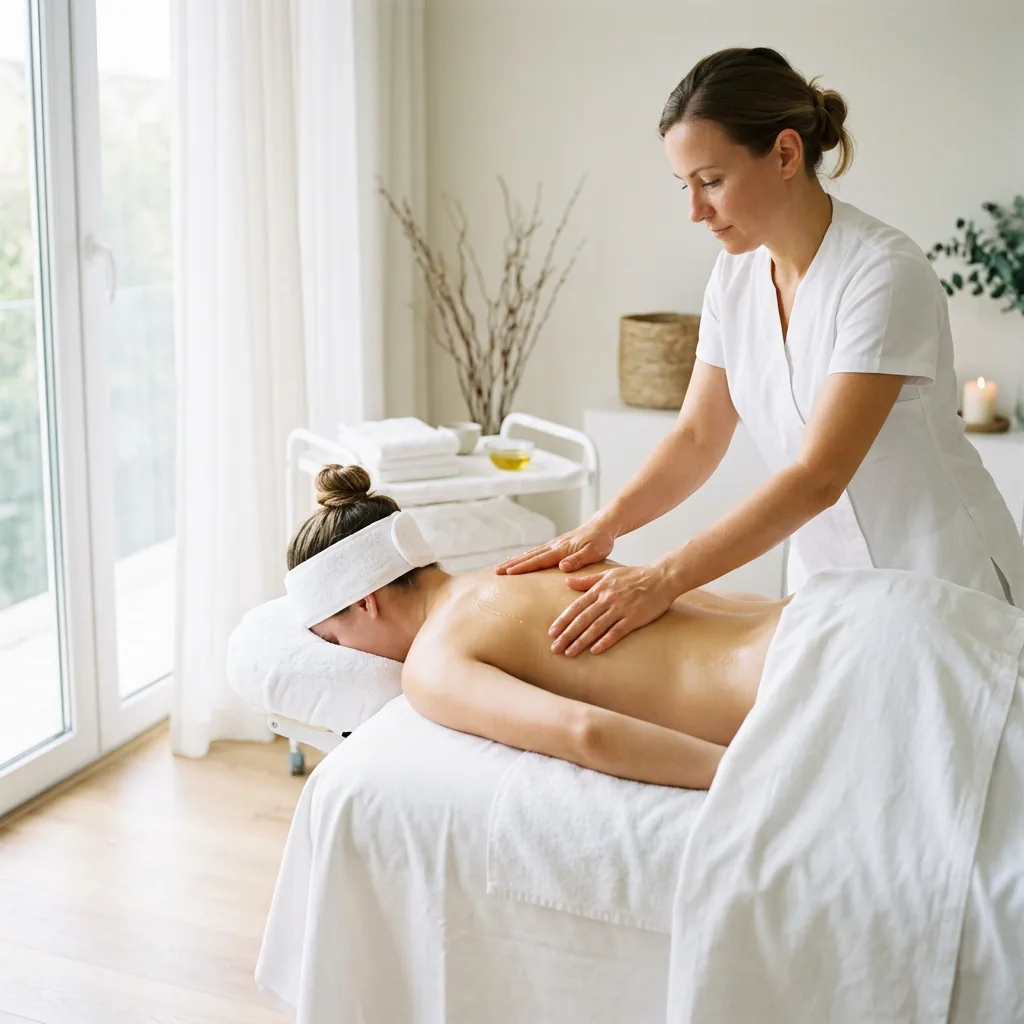
- Session
- $120 · 60 minutes
- Member rate
- $100 · 60 minutes
- Before booking
- OB, midwife or surgeon clearance required
- Hours
- 7 days · 9 AM – 9 PM
— 01
Why the Body Holds So Much Fluid After Birth
Almost nobody warns you about the swelling. You get through the birth, you meet the baby, and then somewhere around the third or fourth day you look down at ankles that seem to belong to someone else, hands too puffy for your rings, and feet that will not go back into the shoes you wore to the hospital. For many parents it is more pronounced after birth than it ever was during pregnancy, which feels backwards until you know what is behind it.
Where all that fluid comes from
Several ordinary things stack up at the same time:
- IV fluids during labor. An epidural, a long induction or a C-section can mean liters of intravenous fluid over many hours. That volume does not disappear at delivery — the body moves it out afterwards, on its own timeline.
- Blood volume built for two. Blood and plasma volume rise substantially across pregnancy and take weeks to settle back toward baseline, so there is simply more fluid in circulation than you are used to carrying.
- A steep hormonal shift. Progesterone and estrogen fall sharply once the placenta is delivered, and the signals governing how the body holds sodium and water recalibrate on their own schedule rather than overnight.
- Gravity and stillness. Recovery involves a great deal of sitting, feeding and healing and not much walking, especially after a caesarean. Fluid settles where gravity puts it: ankles, feet, the backs of the calves, sometimes the hands and face.
Here is the reassuring part, and the part your OB or midwife will most likely tell you first: this kind of swelling is common, usually symmetrical — both legs, both hands — and it usually resolves on its own over a few weeks as the body offloads the extra fluid, often through heavy night sweating and frequent trips to the bathroom. Nothing has to be done about it. Postpartum lymphatic drainage is not a rescue for a problem your body cannot solve by itself; at most it is a quiet hour that some parents find takes the edge off while the body does its own work.
What the lymphatic system actually does
You will see a lot of language online about massage that "flushes toxins." We do not use it, because it is not what this system is. Lymph vessels are a low-pressure drainage network running alongside your circulation: they collect fluid and proteins that leak out of small blood vessels into the tissues, carry immune cells, and return that fluid to the bloodstream by way of lymph nodes. Your liver and kidneys do the actual clearing. Very light, slow, skin-level strokes are simply an attempt to encourage movement in a network that has no pump of its own and depends largely on breathing and muscle activity. For the same technique outside the postpartum window, see our lymphatic drainage massage service page and our page on lymphatic drainage for swelling.
Being honest about the evidence
Research on manual lymphatic drainage in the postpartum period specifically is limited. Most of the better-studied work sits in a different context — post-surgical swelling and lymphedema care delivered by certified specialists — and results elsewhere are mixed. So, plainly: many parents describe a session as deeply relaxing and say their legs felt lighter afterward, and gentle massage is generally considered low-risk for healthy adults. We cannot tell you it will reduce your swelling by any amount, on any schedule, and anyone quoting you a number is guessing. While we are being blunt — this is not a weight-loss service, not a "bounce back" service, and we do not sell belly binding or anything else that claims to reshape a postpartum body. Your body just did something enormous; our only job in this room is comfort.
— 02
What a Session Involves — & How We Adapt It
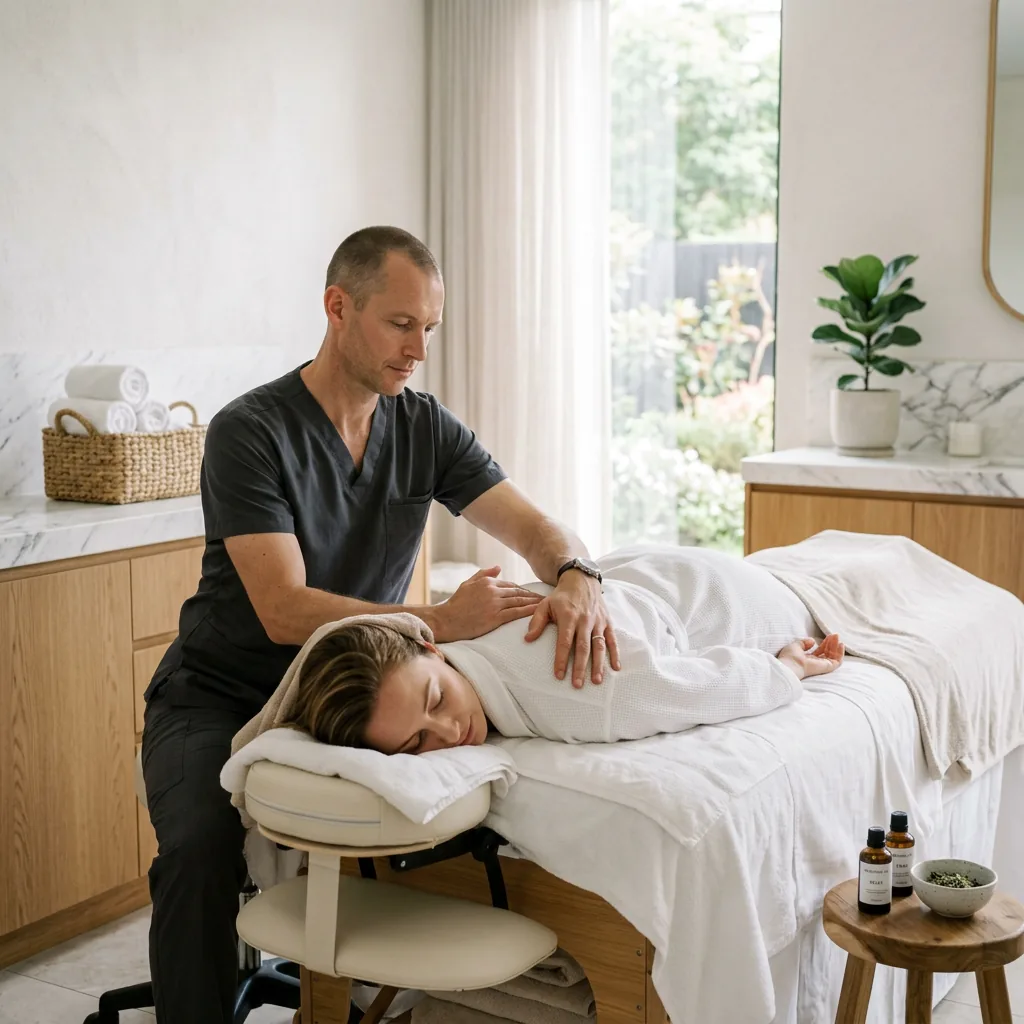
If your experience of massage is deep-tissue work on a knotted shoulder, this will feel like a different service entirely. Lymphatic drainage uses very light pressure — closer to a slow, rhythmic stretch of the skin than to kneading — following a deliberate sequence toward the lymph node clusters at the neck, under the arms, and at the groin. People are routinely surprised by how gentle it is, and by how easy it is to fall asleep.
Before you book: clearance comes first
We ask two questions when you call, every time. How was the birth, and has your OB, midwife or surgeon cleared you for massage? If the answer to the second is no or not yet, we would rather you called them than booked with us. After a caesarean this is not us being over-careful — the incision is a surgical wound, healing happens in layers you cannot judge from the outside, and only the surgeon who made it can say when hands-on work near the abdomen is appropriate. Bring whatever guidance they give you, including any instruction to stay away from a particular area, and we follow it exactly.
The hour itself
- A short conversation first. Type of birth, how many weeks out you are, where the swelling sits, any stitches or incision, whether you are nursing, what your provider said. This happens before the hour starts, not inside it.
- You stay covered and in charge. Draping stays modest, you tell us where not to go, and "that is enough for today" ends the session with no negotiation and no upselling.
- Slow, light, repetitive work. Usually starting at the neck and chest, then the arms, the abdomen if cleared, and the legs. It is quiet work, and that is rather the point.
- An unhurried finish. Water, a slow sit-up, and no rush out of the room.
How we adapt it postpartum
- Side-lying positioning. Lying flat on your stomach is uncomfortable for many people in the early weeks and impossible for some, so we set up side-lying with bolsters and pillows instead — the same approach we use for prenatal and postnatal work.
- Working away from the incision. After a caesarean we stay well clear of the scar and the area around it, and go nowhere near it without explicit surgeon clearance. In any doubt, we skip the region entirely. Nothing about this hour is worth risking a healing wound.
- A shorter first session, if you want one. Plenty of new parents book the full hour and use forty minutes of it. That is fine — we would rather stop early than push through, and nobody here will talk you into staying on the table.
- Nursing comfort. Feed or pump right before you come in if you can; it makes side-lying far more comfortable, and the room is yours privately before or after. Tell us about any tenderness or engorgement and we will simply avoid the chest — and if a firm, painful area comes with fever or chills, please call your provider instead of booking.
- Bathroom breaks, without apology. Many people notice they use the bathroom more in the hours afterward. That is a commonly reported effect rather than a promise, and one more reason not to schedule this twenty minutes before a meeting.
Never had bodywork here before? Our new patient guide covers the practical side — what to wear, where to park, how long to allow.
— 03
Lymphatic Drainage vs. Postnatal Massage
These are two different services on our menu and people mix them up constantly, so here is the plain comparison. Both are hands-on, both run 60 minutes, both require the same clearance from your provider. They differ in pressure, in what they are aiming at, and in price.
| Compare | Postpartum lymphatic drainage | Postnatal massage |
|---|---|---|
| What it is | Very light, slow, repetitive skin-level strokes following a set sequence toward lymph node areas, intended to encourage fluid movement | Traditional Chinese medicine-informed bodywork adapted for a postpartum body — the same service family as our prenatal massage |
| Pressure | Feather-light. Lighter than most people expect, and deliberately so | Light to moderate, calibrated in real time. Firm enough to matter on a tight shoulder, conservative everywhere that deserves caution |
| Typical focus | Puffiness and heaviness — ankles, feet, calves, hands, arms; abdomen only with clearance and never near a healing incision | The muscular toll of newborn care: neck, upper back, shoulders, wrists, low back, hips |
| Session length | 60 minutes | 60 minutes |
| Price | $120 / $100 members | $100 / $80 members |
How to choose
A rough rule that holds up in practice: if the loudest complaint is puffy and heavy, people tend to prefer the lymphatic drainage session. If the loudest complaint is sore and knotted from feeding, carrying and one particular sleeping position, postnatal massage is usually the better hour. Plenty of parents alternate between them across a few weeks, and plenty book one of each and never come back for more — both are entirely reasonable. Our tui na and meridian massage page covers the bodywork lineage behind the postnatal service, and prenatal massage runs at the same $100, or $80 for members, if you are reading this before the birth rather than after.
Membership, in one paragraph
There is no membership fee and no signup form. Buy a package of 5 or more massage sessions and the member rate applies automatically: lymphatic drainage drops from $120 to $100, and massage from $100 to $80. That is the whole program. We mention it because the arithmetic matters when money is tight and a baby has just arrived — not because we think you need a package. If one session is what you want, book one session. The complete menu, with everything else we offer, is on the pricing page and in the price table further down this page.
Neither service reshapes anything, and we will not pretend otherwise. No inch-loss claims, no before-and-after photos, no wraps or binding sold at the desk. You are welcome here at any size, at any point in recovery, and nobody is going to comment on your body.
— 04
When Swelling Is an Emergency — Call, Don't Book
This is the most important section on the page, and if you read nothing else, read this. Most postpartum swelling is ordinary, even when it looks alarming. A few patterns are not ordinary, and they need medical attention the same day — not a massage appointment, not a wellness plan, not a wait-and-see. If any of the following describes you, contact your OB, midwife or doctor immediately, or go to an emergency room.
- Swelling in only one leg, or calf pain, warmth or redness. One-sided swelling can be a sign of a blood clot. Do not massage the leg, do not book a session, and do not wait for it to settle — call your provider or seek emergency care now.
- Swelling with a headache that will not lift, vision changes such as spots or blurring, or pain in the upper abdomen or under the ribs. These can be signs of postpartum preeclampsia. It can appear after a completely normal delivery, and after you have been discharged and sent home — most often in the first week, but up to 6 weeks after birth. It is a medical emergency and it is treatable. Seek care immediately.
- Chest pain or shortness of breath. Call 911 or go to an emergency room. This is never something to sleep on, and never something to bring to a massage table.
- Fever, chills, or an incision or tear that is red, hot, increasingly painful, or draining. These can indicate infection and need medical assessment, not bodywork.
- Heavy bleeding — soaking through a pad in an hour, or passing large clots. Contact your provider or seek emergency care.
We would genuinely rather lose a booking than have someone lie on our table with a clot or with rising blood pressure. If you call to book and describe any of the above, we will tell you to hang up and call your provider — please take that as care, not as a brush-off. And if you are simply not sure whether what you are feeling is normal, your OB or midwife would far rather take that phone call than not.
What we do not treat: lymphedema
If you have been diagnosed with lymphedema, this is not the right service and we will say so before you book. Diagnosed lymphedema is managed by a certified lymphedema therapist using Complete Decongestive Therapy — a structured program combining specialist manual lymph drainage, compression bandaging, exercise and meticulous skin care, delivered in phases and monitored over time. That is a clinical specialty with its own training and credentials. Our therapists are licensed practitioners with 15+ years of experience and more than 5,000 clients served, and none of them is a certified lymphedema therapist. We would rather tell you that plainly than let a job title do work it has not earned. Ask your physician for a referral to a certified lymphedema therapist, and please do not let a spa appointment delay that.
Other reasons we will postpone or decline
- An active infection anywhere in the body, or a fever
- A known or suspected blood clot
- Congestive heart failure
- Kidney failure
- Active, untreated cancer without clearance from your oncologist
- Any situation where your OB, midwife or surgeon has not cleared you for massage — including the entire period after a caesarean until your surgeon says otherwise
These are the standard cautions for this kind of work, and the reasoning is straightforward: encouraging fluid movement is not appropriate when the underlying issue is a heart or kidney problem, an infection that could spread, or a clot that must not be disturbed. If any of these apply to you, your medical team decides what happens next, not us.
— 05
Fitting a Session Around a Newborn
The logistics are usually harder than the decision. Feeding windows, a car seat, the odds of a nap holding, and the fact that most spas around Tysons keep hours that assume you are free between ten and four on a Tuesday. We are open 7 days a week, 9 AM to 9 PM, which in practice means the two slots that actually work for new parents both exist: the early morning one before the day falls apart, and the evening one after a partner or a grandparent gets home. Same-week appointments are the norm rather than something you have to plead for.
Getting here
We are at 1481 Chain Bridge Rd, Ste 300, in McLean — a couple of minutes off Route 123, which is how most people arrive from Vienna, Tysons, Arlington and Falls Church. Parking is free and on-site, so there is no garage spiral, no meter app and no long walk with a diaper bag. Elevator to the third floor. Coming over the American Legion Bridge from Bethesda or Potomac, the drive is short outside rush hour and genuinely miserable inside it — aim for mid-morning or evening.
Practical tips from parents who have done this
- Book after a feed, not before one. Comfort on the table improves dramatically, and so does your peace of mind.
- Bring a second adult if you can. Someone who can walk the hallway with the baby is worth more than anything we can do with our hands. A car seat beside the table is welcome either way — we just cannot hold or settle your baby while working, and if you are needed mid-hour we stop, with no clock-watching and no penalty.
- Ask for side-lying up front. You do not need to prove you can lie flat. Say the word at booking and the table is set up before you arrive.
- Keep expectations modest. Some parents book one session out of curiosity; some space a few across several weeks. There is no protocol here and no number of sessions we are steering you toward.
- Plan a soft landing. Drink water and schedule nothing demanding for the hour afterward — most people feel pleasantly heavy-limbed and want a slow drive home.
- Loose, comfortable clothes. Waistbands are nobody's friend in the early weeks.
Booking and questions both work over text. Message us at 240-715-5939 with how far out from birth you are and what your provider said, and we will tell you honestly whether this is the right hour for you or whether you should wait. We speak English and Mandarin Chinese, both at the desk and in the room. If your questions run wider than swelling — cycles restarting, sleep, mood, the long arc of recovery — our women's health page covers that side of things, and the full price list is one click away with no surprises on it.
— Pricing
| Massage Therapy | Price | Member |
|---|---|---|
| Meridian massage · 60 minutes | $100 | $80 |
| Deep tissue massage · 60 minutes | $100 | $80 |
| Prenatal massage · 60 minutes | $100 | $80 |
| Postnatal massage · 60 minutes | $100 | $80 |
| Lymphatic drainage massage · 60 minutes | $120 | $100 |
Membership is automatic when you purchase a package of 5 or more massage sessions — no fee, no signup. Member rates are shown in the right-hand column.
Membership
Purchase a package of 5 or more massage therapy sessions and you're automatically a member — no separate signup, no fee.
- Massage at the member rate of $80 / 60 minutes
- Lymphatic drainage at the member rate of $100 / 60 minutes
- Free cupping therapy add-on
- Free gua sha therapy add-on
- Free hot stone therapy add-on
Parking & arrival
Free parking — easy in, easy out on Chain Bridge Rd
Open every day 9 AM – 9 PM — lunch-break, after-work, and weekend visits all fit.
- Park free directly on-site at 1481 Chain Bridge Rd, Ste 300 — no garages, no meters.
- Look for the red-brick building; we're in Ste 300 with signage at the entrance.
- Arrive 10 minutes early for your first visit to settle in — WiFi and a snack bar are waiting.
— Questions
Asked & answered.
When can I start lymphatic drainage after a vaginal birth or a C-section?
How much does postpartum lymphatic drainage cost in McLean?
Is lymphatic drainage safe while I'm breastfeeding?
Can I bring my baby to the appointment?
How many lymphatic drainage sessions will I need?
My swelling is getting worse instead of better — should I book a session?
— Research & references
NCCIH — Massage Therapy: What You Need To Know
NCCIH notes that massage may help with some kinds of pain and stress for some people, while research on specific populations is still developing.
NCCIH — Things To Know About Massage Therapy for Health Purposes
NCCIH advises talking with your health care provider before starting massage, particularly with any medical condition — the reason we ask for clearance first.
AMTA — Massage Can Improve Health and Wellness
The American Massage Therapy Association's position statement summarizes research suggesting massage may support comfort and general wellness, hedged as it should be.
Citations are summarized — please consult the original sources. This page is general health education, not medical advice for your specific case; results vary and acupuncture works best alongside, not instead of, care from your physician.
— Keep exploring
Service
Lymphatic Drainage Massage
The full service page — technique, pressure, and what an hour actually looks like.
Service
Tui Na & Meridian Massage
The bodywork lineage behind our prenatal and postnatal massage, $100 / $80 members.
Condition
Pregnancy & Prenatal Acupuncture
Safety-first care through all three trimesters and the fourth.
Condition
Lymphatic Drainage for Swelling
Puffiness, heaviness, and fluid retention outside the postpartum window.