— Conditions · TMJ & Jaw Pain
Acupuncture for TMJ & Jaw Pain in McLean, VA
Clenching through the workday, grinding through the night, a jaw that clicks or tires halfway through dinner. Here is what acupuncture can honestly offer — and why your dentist stays at the center of the plan.
Quick answer
Acupuncture for TMJ and jaw pain is a drug-free, reversible treatment in which a licensed practitioner places thin sterile needles in the chewing muscles around the temporomandibular joint (TMJ) and at distant points on the hands, starting with an initial session of 60 minutes for $150. Follow-ups are 30 minutes for $100, and a package of 5 sessions is $400 — $80 per visit. Harmony Acupuncture & Wellness Spa is open 7 days, 9 AM to 9 PM, at 1481 Chain Bridge Rd, Ste 300, McLean, with free parking at the door. The National Institute of Dental and Craniofacial Research (NIDCR) rates the evidence as limited, so we treat acupuncture as a complement to your dentist's care, not a replacement.

- Initial visit
- $150 · 60 minutes
- Follow-up
- $100 · 30 minutes
- Package
- 5 sessions · $400
- Evidence (NIDCR)
- Limited — a complement, not a cure
— 01
TMJ, TMD and jaw pain: what is actually going on.
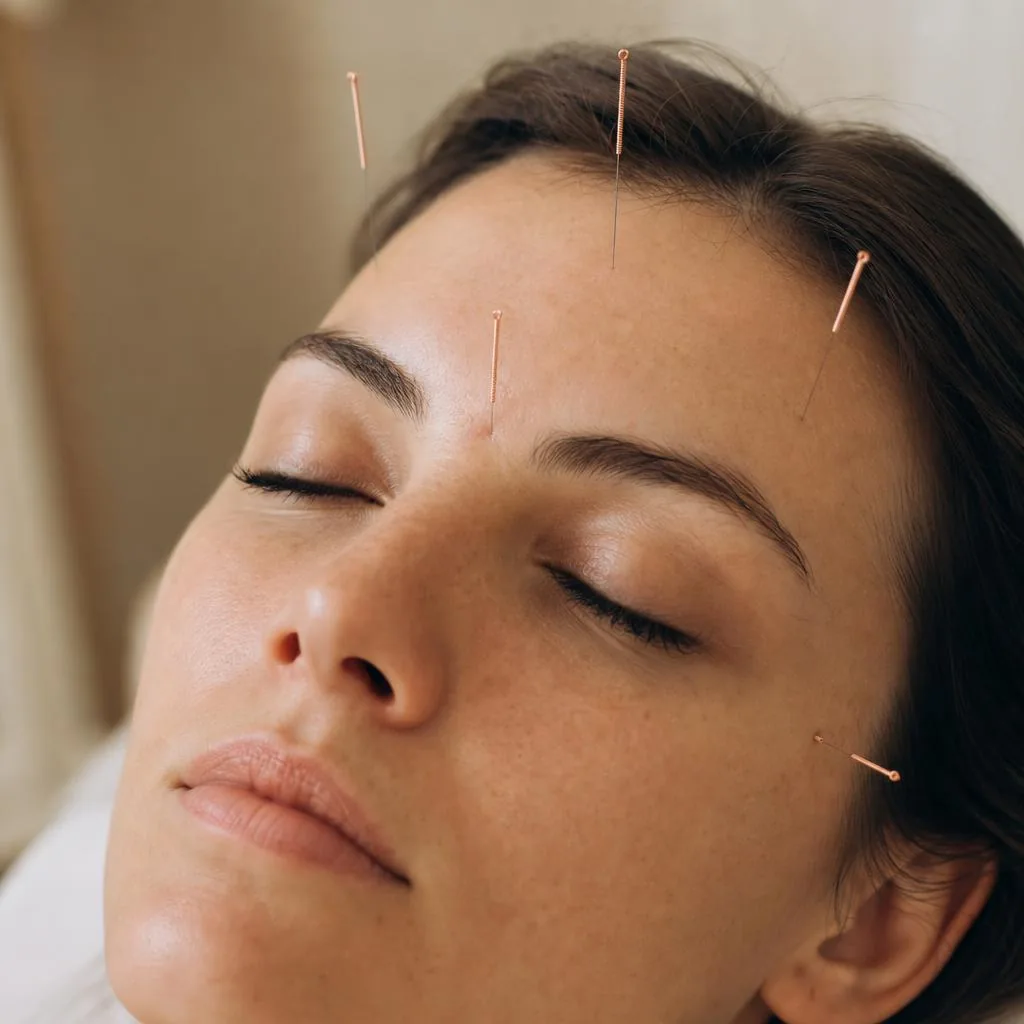
Your temporomandibular joints (TMJ) are the two hinges that connect your lower jaw to your skull, one in front of each ear — press your fingertips there and open your mouth, and you can feel them move. Temporomandibular disorders (TMD) are the problems that develop in those joints and in the chewing muscles that work them.
The National Institute of Dental and Craniofacial Research counts more than 30 separate conditions under the TMD label, sorted into three groups: disorders of the joint itself, including the small disc that cushions it; disorders of the chewing muscles; and headaches associated with a TMD. Roughly 5% of U.S. adults are affected, and the conditions are about twice as common in women, especially between the ages of 35 and 44. Many episodes settle on their own. Some become long-lasting, and those often travel with company — headaches, back pain, sleep problems, irritable bowel syndrome or fibromyalgia.
What jaw pain from a TMD usually feels like
- Aching in the chewing muscles or the joint — the most common symptom — sometimes spreading into the face or neck
- Stiffness, limited opening, or a jaw that catches or locks
- Clicking, popping or grating that hurts as you open or close
- Ringing in the ears, hearing loss or dizziness
- A sense that your teeth no longer meet the way they used to
One reassurance worth having early: clicking or popping without pain is common, considered normal, and does not need treatment, according to NIDCR. A jaw that clicks quietly at breakfast is not a diagnosis.
Clenching, grinding and the desk
Nobody knows exactly why most TMDs start. NIDCR points to a mix of genes, life stress and how an individual processes pain, and notes that research does not support the old idea that a bad bite or braces cause them. What patients describe, though, is familiar: teeth pressed together through a tense afternoon of calls, a jaw that aches by evening, a partner who hears grinding at night. Cutting back on clenching is one of the first self-care steps NIDCR lists, and noticing it is half the work — lips together, teeth apart, tongue resting on the roof of the mouth is the resting position many dentists suggest.
If stress is the engine behind your clench, our page on acupuncture for stress and anxiety covers that side of the picture.
— 02
Your dentist first, then acupuncture.
A dentist or physician is the right first stop for jaw pain, because there is no single standard test for TMD and several other problems can feel identical — a cracked tooth, an abscess, sinus pressure, an ear infection. NIDCR notes that a clinician may need to rule those out before calling anything a TMD. Acupuncture belongs after that conversation, not instead of it.
Once other causes are excluded, NIDCR's advice is unusually clear: because the evidence for most TMD treatments is limited, start conservative and avoid anything that permanently changes the jaw joints, teeth or bite. The usual first steps are soft foods, heat or cold paired with gentle jaw-stretching and strengthening exercises, over-the-counter nonsteroidal anti-inflammatory drugs (NSAIDs) such as ibuprofen, and cutting back on clenching, gum chewing and nail biting.
| Who | What they bring | Worth knowing |
|---|---|---|
| Dentist | Examination, ruling out tooth and gum causes, night guards (also called splints or bruxism appliances) | A guard protects the teeth and may help break a clenching habit. NIDCR says there is not much evidence that guards reduce TMD pain, and none should be designed to permanently change your bite. |
| Physician | Ruling out ear, sinus and nerve causes; prescription medicines when appropriate | NIDCR notes limited evidence on which medicines work best, and some carry real risks — ask how long to take them. |
| Physical therapist | Manual therapy and a jaw exercise program | Research suggests hands-on stretching of the muscles around the joint can improve function and ease pain. |
| Psychologist | Cognitive behavioral therapy and biofeedback | Biofeedback can use a sensor on the jaw to show you when you are clenching, so you can learn to release it. |
| Licensed acupuncturist | Fine needling of the chewing muscles plus calming points elsewhere | Reversible, and leaves the bite untouched. NIDCR calls the evidence limited, so treat it as a supporting role. |
What every option on that list shares is reversibility. NIDCR warns that occlusal treatments — grinding down teeth, adding crowns, or orthodontics to change the bite — lack evidence for TMD and sometimes make things worse, and MedlinePlus cautions that surgery, sometimes suggested when severe symptoms persist, may not work or may even worsen them. Acupuncture sits comfortably in the conservative tier: if it does not help you, you stop, and nothing about your jaw has changed. New to needles? Our new patient guide explains what a first visit involves.
— 03
How acupuncture approaches a clenched jaw.
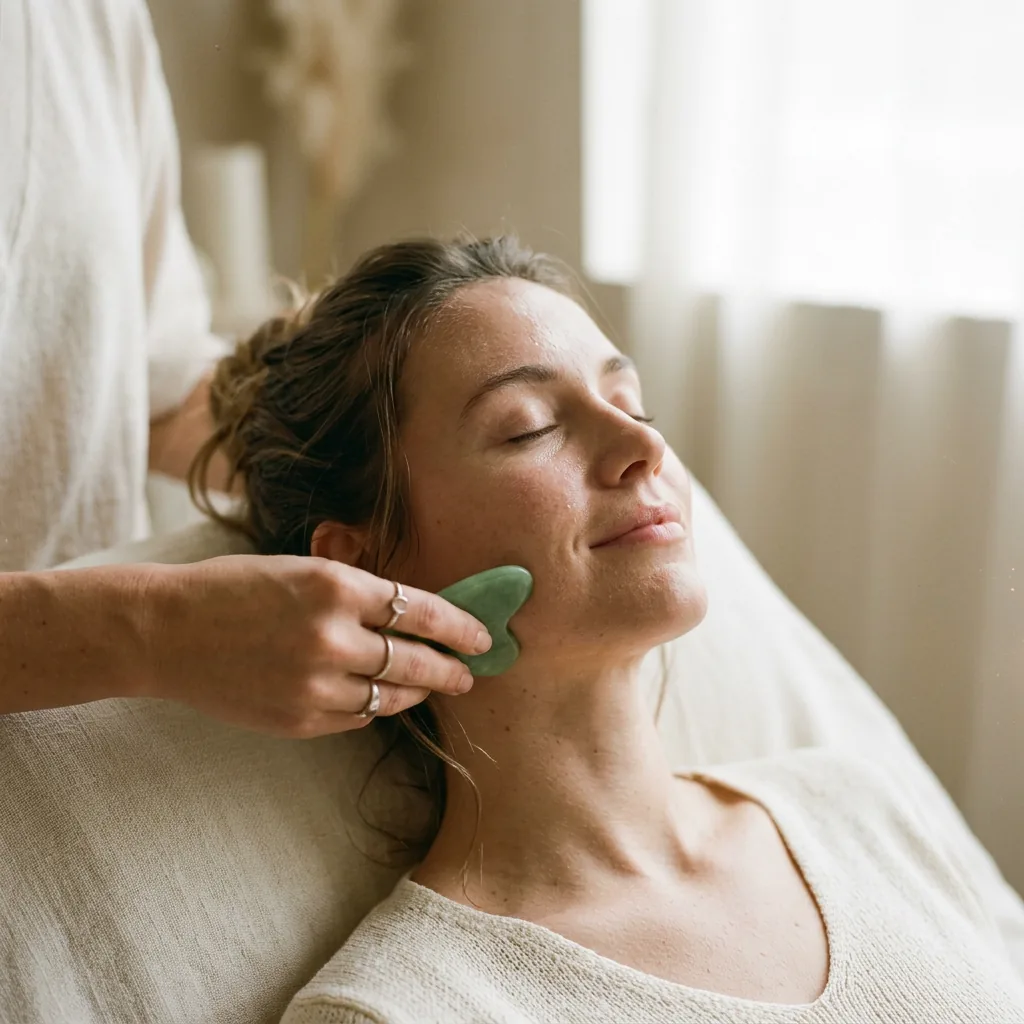
Acupuncture for a clenched, aching jaw works on two levels at once: the overworked chewing muscles themselves, and the wider stress response that keeps them switched on. Fine sterile needles go into a few local points around the joint, and into distant points — most often on the hands — that Traditional Chinese Medicine (TCM) has long paired with the face.
The points you are likely to meet
- ST6 (Jiache) — in the bulk of the masseter, the thick chewing muscle you can feel bunch up at the angle of the jaw when you clench.
- ST7 (Xiaguan) — just in front of the ear, below the cheekbone, close to the joint itself.
- SI19 (Tinggong) — in front of the small flap of the ear, often chosen when the ache spreads toward the ear.
- GB20 (Fengchi) — at the base of the skull, because jaw tension and upper-neck tension tend to travel together.
- LI4 (Hegu) — in the web between thumb and index finger; classical TCM texts name it the command point for the face and mouth. It is traditionally avoided in pregnancy, so tell your practitioner if you are or might be pregnant.
In TCM terms, the Stomach, Small Intestine and Gallbladder channels all cross the side of the face, and clenching that worsens with stress is often read as constrained Liver qi — a pattern treated as much with calming points as with local ones. The research vocabulary is different: needling a tight, tender band in the masseter may provoke a brief twitch and then a release, and acupuncture appears to influence how the nervous system processes pain. Both explanations are plausible; neither is proven for TMD.
What a session feels like
You rest face-up in a private room. The needles are hair-thin; near the jaw most people feel a dull, spreading heaviness in the muscle rather than sharpness, and the masseter sometimes twitches once as it lets go. If needles near your face make you uneasy, say so — a distal-only treatment using hand, forearm and leg points is a reasonable way to start. Some people pair needling with hands-on work: gua sha stroked lightly along the jawline is a $20 add-on to any massage, and free for members — membership comes with buying a package of 5 or more massage sessions, with no fee and no signup.
When the headache is the main event
Jaw pain and headache overlap so often that NIDCR files "headaches associated with a TMD" as one of its three groups. If yours mostly announce themselves as temple pain, morning headaches or full migraines, start with our acupuncture for migraines and headaches page; if they climb up from tight shoulders, neck and shoulder pain is the better map. Most people with a clenching habit carry some of all three, and the first session is where we sort out which thread to pull first.
— 04
What research shows — and its limits
The research on acupuncture for TMD is thin, and the most authoritative summary says so plainly. NIDCR, the federal institute that studies jaw and facial disorders, describes acupuncture as one of two complementary treatments studied for TMD — the other is transcutaneous electrical nerve stimulation (TENS) — and concludes there is limited evidence that it helps.
The broader picture is a little more encouraging. The National Center for Complementary and Integrative Health (NCCIH) groups temporomandibular joint dysfunction with fibromyalgia, irritable bowel syndrome and other chronic conditions that often occur together, and describes a 2017 review that found evidence acupuncture, massage, relaxation techniques, yoga and tai chi may have some benefit for chronic pain in general. MedlinePlus, from the National Library of Medicine, adds that some dentists and physicians do recommend acupuncture despite the limited evidence. That is a reason to consider a trial, not a promise about your jaw.
Now the limits. Acupuncture cannot reposition a displaced joint disc, reverse arthritis in the joint, or change how your teeth meet. Limited means exactly that — not enough good studies to say acupuncture reliably helps TMD — and in acupuncture research generally, part of the measured benefit shows up with sham needling too — expectation and the calm of the session contribute. Some people with jaw pain notice the muscles loosening and their clench easing; others notice little. None of that is a reason to skip your dentist's plan.
Safety is the stronger part of the case. NCCIH notes that relatively few complications have been reported, that the U.S. Food and Drug Administration (FDA) regulates acupuncture needles as medical devices that must be sterile and labeled for single use, and that serious problems can occur when treatment is not delivered properly. Every session here uses single-use sterile needles placed by licensed practitioners.
— 05
Red flags, a fair trial and insurance.
Some jaw pain is not a TMD at all, and a few kinds are emergencies. Get medical care before booking acupuncture — and call 911 where noted — if any of these apply:
- Jaw pain with chest pain, pressure, shortness of breath, sweating or nausea — heart trouble can show up in the jaw. Call 911.
- A jaw locked open or locked closed — same-day dental or urgent care.
- Facial or jaw swelling with fever, or a hot, throbbing tooth — possible infection.
- New numbness, tingling or weakness in the face, or one side of the face drooping — call 911 if it comes on suddenly.
- Over 50 with a new headache, scalp tenderness, an ache in the jaw that comes on while chewing, or any change in vision — same-day medical care.
- Unexplained weight loss, a lump in the face or neck, or pain that keeps building despite rest.
For ordinary, stable symptoms, a defined trial is the honest approach. There is no research-set number of sessions for TMD, so we suggest judging your response across the 5 session package — $400, or $80 per 30 minute visit — after the 60 minute initial session. Keep a simple note of morning jaw tightness and how wide you can open; if nothing has shifted by the end of the package, we will say so rather than book more. Ready to start? Book a first visit for jaw pain or call (240) 715-5939.
On cost: Medicare covers acupuncture only for chronic low back pain, so it will not pay for jaw treatment. Commercial plans vary; we accept UnitedHealthcare and Aetna for acupuncture, and the fastest route is to text your policy details to 240-715-5939 for a free benefits check. Massage and its add-ons are self-pay. Our insurance page has the details, and our McLean acupuncture clinic page covers hours, parking and directions to 1481 Chain Bridge Rd.
— Pricing
| Acupuncture | Price |
|---|---|
| Initial session · 60 minutes | $150 |
| Follow-up session · 30 minutes | $100 |
| Package · 5 sessions (30 minutes each)($80 per visit) | $400 |
Insurance patients: sessions are billed through your plan — text us your policy info for a free benefits check.
Parking & arrival
Free parking — easy in, easy out on Chain Bridge Rd
Open every day 9 AM – 9 PM — lunch-break, after-work, and weekend visits all fit.
- Park free directly on-site at 1481 Chain Bridge Rd, Ste 300 — no garages, no meters.
- Look for the red-brick building; we're in Ste 300 with signage at the entrance.
- Arrive 10 minutes early for your first visit to settle in — WiFi and a snack bar are waiting.
— Questions
Asked & answered.
Can acupuncture stop my jaw from clicking?
Probably not, and it may not need to. NIDCR notes that clicking or popping without pain is common, considered normal and needs no treatment. Painful clicking, catching or locking is different — have a dentist examine it first. Acupuncture cannot reposition the small disc inside the joint; what it may do is ease the muscle tension around a joint that is already irritated.
Do I still need my night guard if I start acupuncture?
Keep wearing it if your dentist prescribed one. A night guard protects your teeth from grinding wear, which needles cannot do. NIDCR is candid that evidence on guards for TMD pain itself is limited, and adds two rules: the appliance should not be designed to permanently change your bite, and if it causes pain, stop and talk to your dentist.
Where do the needles go for TMJ?
Usually a few local points — in the masseter at the angle of the jaw and just in front of the ear — plus distant points on the hands, often the web between thumb and index finger, and sometimes the base of the skull. If needles near your face feel like too much, a hand-and-leg-only treatment is a reasonable place to start.
Is TMJ caused by stress or a bad bite?
Usually neither on its own. NIDCR says the exact cause of most TMDs is unclear, and research points to a combination of genes, psychological and life stressors, and how a person processes pain. It specifically does not support the belief that a bad bite or braces cause TMD — one reason it advises against treatments that permanently reshape the teeth.
Does insurance cover acupuncture for TMJ?
Sometimes, through a commercial plan. We accept UnitedHealthcare and Aetna for acupuncture, but benefits vary by policy, so text your details to 240-715-5939 for a free check before you book. Medicare is a firm no here: it covers acupuncture only for chronic low back pain, not jaw or facial pain.
Why does my ear hurt when the problem is my jaw?
The joint sits directly in front of the ear canal, so jaw-joint pain is often felt as earache, and NIDCR lists ringing in the ears, hearing loss and dizziness among possible TMD symptoms. Ear pain with fever, discharge or sudden hearing loss is a different matter — see a physician or an ear, nose and throat specialist first.
— Research & references
NIDCR — TMD (Temporomandibular Disorders)
Reports limited evidence that acupuncture helps TMD and recommends conservative care before any treatment that permanently changes the teeth, bite or joint.
MedlinePlus — Temporomandibular Disorders
Notes that symptoms are temporary for many people, that complementary treatments have limited evidence, and that surgery may not work or may worsen symptoms.
NCCIH — Chronic Pain and Complementary Health Approaches: Usefulness and Safety
Groups temporomandibular joint dysfunction with other overlapping chronic conditions and describes a 2017 review suggesting acupuncture may have some benefit for chronic pain in general.
NCCIH — Acupuncture: Effectiveness and Safety
Notes that relatively few complications have been reported and that the FDA requires acupuncture needles to be sterile and labeled for single use.
Citations are summarized — please consult the original sources. This page is general health education, not medical advice for your specific case; results vary and acupuncture works best alongside, not instead of, care from your physician.
— Keep exploring
Condition
Migraines & Headaches
When jaw tension mostly shows up as temple pain or morning headaches.
Condition
Neck & Shoulder Pain
A clenched jaw and raised shoulders usually arrive as a set.
Condition
Anxiety & Stress
For the clench that starts in a stressful week rather than the joint.
Location
Acupuncture in McLean, VA
Chain Bridge Rd clinic — open 7 days, free parking at the door.