— Harmony Journal · First-Visit Nerves
Does Acupuncture Hurt — or does it just feel strange?
Most people brace for a flu shot. What usually arrives is a brief prick and then a dull, heavy ache. Here is the full map of sensations — including the ones you should never sit through.
Quick answer
Acupuncture needling sensation is usually a brief prick at insertion followed by a dull ache, heaviness, tingling or spreading fullness known as de qi, felt while solid, sterile needles slightly thicker than a human hair rest for 20 to 30 minutes. Sharp, burning or electric pain is not part of it and should be reported at once. At Harmony Acupuncture & Wellness Spa in McLean, a first visit is 60 minutes for $150, with a consultation before any needle is placed; follow-ups are 30 minutes for $100. Whether acupuncture hurts for you varies by person and by point, and only a first session answers that.
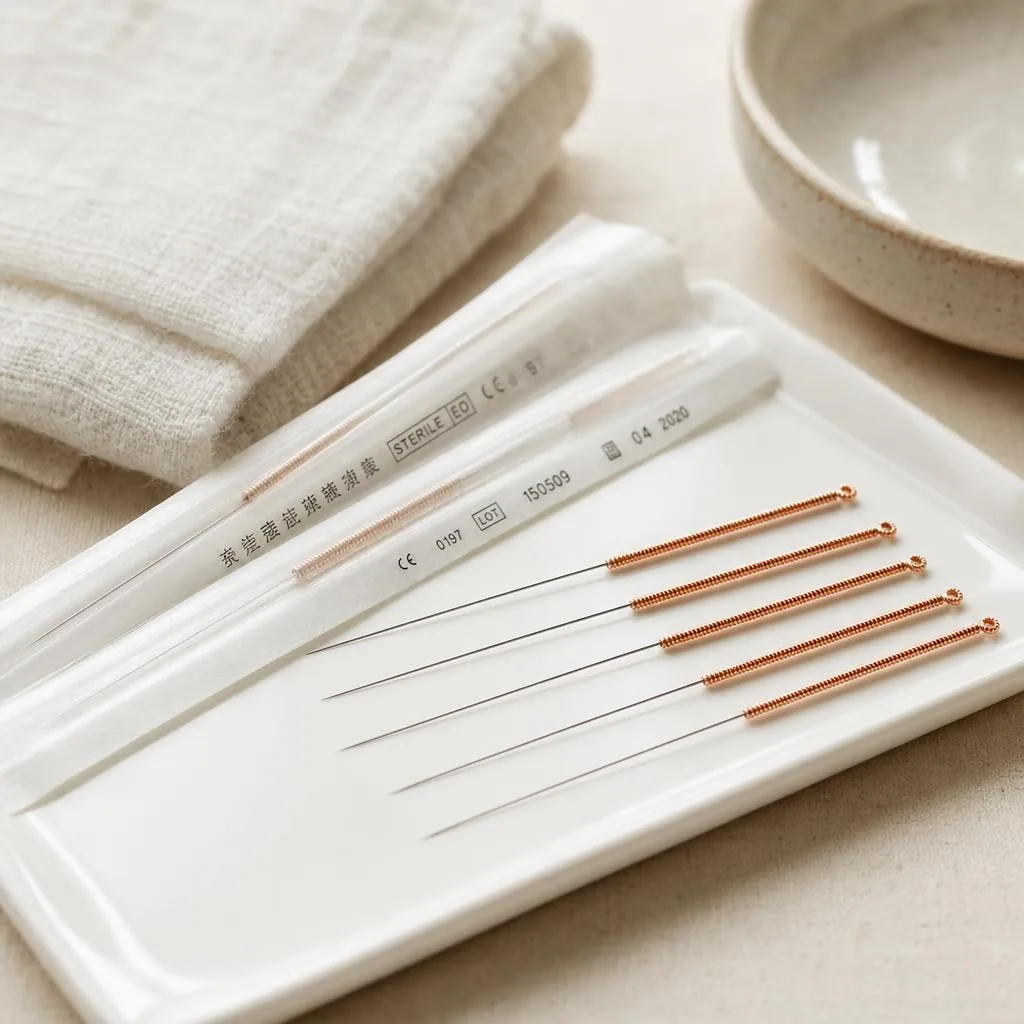
- The needle
- Solid, sterile, single-use
- Normal
- Dull ache, heaviness, tingling
- Not normal
- Sharp, burning or electric pain
- First visit
- $150 · 60 minutes
— 01
Most people brace for a shot. An acupuncture needle is a different tool.

Needle fear is usually borrowed from somewhere else: a flu shot, a blood draw, a dentist's injection. Those needles are hypodermic — hollow tubes built to carry fluid in or out, with a bore wide enough for blood to pass through. An acupuncture needle has no bore and carries nothing, so it can be made far finer, and that difference does most of the work.
The U.S. Food and Drug Administration (FDA) regulates acupuncture needles as medical devices. Its classification defines one as "a solid, stainless steel needle," optionally fitted with a handle, and requires each needle to be sterile and labeled for single use. The National Cancer Institute (NCI) describes them as "slightly thicker than a human hair." Most of what you see in a photo of acupuncture is the handle; the part that enters the skin is a fine, flexible wire.
Acupuncture also differs from an injection in what happens next. Nothing is injected, so the sting many people associate with a shot — fluid pushing into muscle — is simply absent. The needle goes in, and then it stays put while you rest. That is why the question "does acupuncture hurt?" deserves a more precise answer than yes or no: the sensations it does produce are unfamiliar, and an unfamiliar sensation is easy to mislabel as pain.
So this guide spends most of its time on vocabulary. Knowing in advance what dull, heavy and spreading mean makes a first session far less startling; being told "you won't feel a thing" and then feeling something does the opposite. One caution if a friend's story sounds brutal: check whether it was dry needling, which often aims to provoke a twitch in a tight band of muscle. Our dry needling vs acupuncture comparison explains why the two can feel so different.
— 02
Experts sort needle sensations into two lists. Learn both.
De qi is the Traditional Chinese Medicine (TCM) name for the sensation that builds around a needle once it reaches its point, and practitioners treat it as distinct from pain. In a 2006 study, 20 experienced acupuncturists rated 25 needling sensations and sorted them into two clusters: one belonging to de qi, one to acute pain at the needle site.
Seven sensations landed on the de qi list: aching, dull, heavy, numb, radiating, spreading and tingling. Nine landed on the pain list: burning, hot, hurting, pinching, pricking, sharp, shocking, stinging and tender. The NCI's patient summary describes de qi in the same terms — heaviness, numbness or tingling. Here is how to use the two lists on the table:
| What you might feel | Which list experts put it on | What to do |
|---|---|---|
| Aching or dull | De qi | Normal. Breathe out and let the muscle around it go soft. |
| Heavy | De qi | Normal. Many people describe a limb feeling weighted, sinking into the table. |
| Numb or tingling around the point | De qi | Normal while the needle is in; mention it if it lingers after the needles come out. |
| Radiating or spreading | De qi | Normal when it is a dull, travelling ache; speak up if it turns electric. |
| Sharp, pricking, stinging or pinching | Acute pain | Tell your practitioner. A sharp spot that lingers past insertion can be adjusted. |
| Burning or hot | Acute pain | Tell your practitioner straight away. |
| Shocking, like an electric jolt | Acute pain | Say so at once; the needle should come out or be repositioned. |
A 2013 review in Evidence-Based Complementary and Alternative Medicine put the distinction bluntly: dull pain is considered de qi, while sharp pain is not, and brain-imaging work suggests sharp pain reflects inadvertent noxious stimulation rather than the intended sensation. Practitioners differ on how strong de qi needs to be, and whether it matters for results is still debated — the same review found no strict randomized trial proving it necessary. What nobody argues is that sharp pain is the goal.
The moment of insertion
The insertion itself is usually the briefest part: a quick prick or flick at the skin, often over before you have decided whether it hurt. The NCI lists "soreness and pain during treatment" among acupuncture's side effects, so the honest claim is not "painless." The honest claim is that insertion is brief, the sensation afterwards is mostly dull rather than sharp, and you control what happens next by speaking up.
— 03
Where acupuncture hurts more — and where you will barely notice.

Acupuncture hurts more in some places than others, and the pattern is fairly predictable. Skin packed with nerve endings — fingertips, the web between thumb and index finger, the soles and toes, parts of the face — tends to register insertion more sharply. Thick, padded muscle across the back, shoulders, buttocks and thighs usually registers less at the skin and more as a deep, dull ache.
The points on your plan are chosen for a reason, but they are rarely the only route. Many treatment goals can be approached through more than one set of points, and a first session can start with less sensitive areas — the forearms, lower legs or upper back — before moving toward the hands or feet, if those are needed at all. Ask about it at the consultation rather than gritting your teeth through it.
Your body on the day matters too
Sensitivity is not fixed. Being exhausted, hungry, cold, wired on caffeine or braced for the worst can all make the same needle feel louder. A tense muscle can grip a needle and turn a mild ache into a cramp-like one; a muscle that is allowed to go soft usually lets the sensation settle. That is the reasoning behind the advice in the next section, and part of why many people find a second session easier than the first.
Expectation plays a part as well. Someone lying rigid and waiting for pain notices every flicker of sensation; someone who knows that a dull, spreading heaviness is the expected feeling tends to let it pass. Neither is a matter of toughness. Both are a matter of having the right map before you lie down.
— 04
What actually makes the needles easier.
Needle comfort is partly preparation and partly communication, and both are in your hands. None of the steps below require toughness. They work by lowering the tension you bring to the table, and by giving your practitioner the information to adjust before a sensation turns into a problem.
- Eat a light meal an hour or two before. The NCI lists feeling lightheaded among acupuncture's side effects, and arriving on an empty stomach may make it more likely.
- Say you are nervous before anything starts. It changes what your practitioner does: fewer needles, gentler points, more narration. A first session can be deliberately light.
- Breathe out as the needle goes in. Some practitioners cue an exhale at insertion; a slow breath out keeps your shoulders from rising to meet the needle.
- Stay still once the needles are in. Shifting position tightens the muscle around a needle and can turn a quiet point into an ache. If you need to move, ask first.
- Report sensations in plain words. "Dull and heavy" and "sharp and stinging" mean different things here; the table above is the vocabulary.
- Arrive calm rather than wired. A late, rushed arrival on a strong coffee makes it harder to let muscles soften. Ten unhurried minutes in the waiting area are worth having.
If needles genuinely frighten you
Needle anxiety is fairly common, and it is not a character flaw. If you have ever fainted at a blood draw or a vaccination, say so when you book and again at the consultation. Acupuncture is given lying down, which helps, but a fainting history changes how a first session should be paced. Looking away is fine. So is asking for a single needle first, to learn what it feels like before anything else happens.
And if needles are a firm no, there is a needle-free way into the same tradition. Meridian and tui na massage works along the same channel map with hands instead of needles, and some people use it as a first step before deciding whether to try acupuncture at all. That is a legitimate choice, not a consolation prize.
— 05
When acupuncture hurts the wrong way, speak up.
Pain that is sharp, burning or electric, or that grows rather than settles, is not part of normal acupuncture and should never be sat through politely. Say so the moment you notice it. A needle that lands badly is usually a matter of quick adjustment, and the conversation takes seconds; staying quiet to seem brave is the only real mistake available.
Some sensations matter after the session, too. Contact your practitioner — and a physician where noted — if any of these happen:
- Numbness, tingling or weakness that persists after the needles are out, or spreads down a limb. Tell your practitioner, and see a physician if it does not settle.
- A needle site that gets worse over the following days — redder, hotter, swollen or weeping. Infection is among the risks the NCI lists; see a physician.
- Sudden chest pain or shortness of breath after needling on the chest, upper back or shoulders. Seek urgent care or call 911. Punctured organs are among the serious complications the National Center for Complementary and Integrative Health (NCCIH) links to improperly delivered acupuncture; they are rare, but this is not a wait-and-see symptom.
- Feeling faint, sweaty or clammy during or after a session. Tell your practitioner immediately and stay lying down.
- Bruising that is large, spreading or keeps appearing, especially if you take blood thinners or have a bleeding disorder. Mention it, and check with your physician.
Keep the scale in proportion. The NCCIH notes that relatively few complications from acupuncture have been reported, and that complications have come from nonsterile needles and improper delivery. In a German study that followed 229,230 patients through an average of about 10 treatments with physician acupuncturists, the most common side effect was a bleeding spot or bruise, and 1.7 percent of patients reported pain as an adverse effect. Our full guide to acupuncture side effects and safety covers the rest.
— 06
After the needles come out: what is normal.
The hours after an acupuncture session are usually quiet. Some people feel loose and slightly drowsy, and the NCI lists feeling tired, lightheaded or sleepy among acupuncture's side effects. Sit up slowly when the needles are out, take a minute before standing, and give yourself a soft landing rather than a sprint back to the inbox or the gym.
A point or two may feel tender, like a pressed bruise, for a day or so, and you may find a small bruise at a needle site — the most commonly reported minor effect in large surveys. Both usually fade on their own. What is not normal is listed in the section above, and anything on that list outranks this one.
Your first visit, if you decide to try it
At Harmony Acupuncture & Wellness Spa, the first visit is 60 minutes and $150: a consultation about your health history and what you want help with, then treatment, with the needles resting while you lie still in a private room. Follow-ups are 30 minutes at $100, and a package of 5 sessions is $400, or $80 per visit. Before anything starts, tell us about blood thinners, a bleeding disorder, pregnancy or a history of fainting.
How many visits it takes is a separate question with its own evidence; our guide to how many acupuncture sessions you need covers it. The new patient guide walks through preparation, and the clinic itself — 1481 Chain Bridge Rd, Ste 300, open 9 AM to 9 PM, 7 days a week, with free parking at the door — is described on our acupuncture in McLean, VA page. Questions first? Text 240-715-5939.
This article is general health education, not medical advice. It describes typical needling sensations and published safety findings; it does not promise a painless session. Any new or worsening symptom after acupuncture deserves a call to your physician.
— Questions
Asked & answered.
Does acupuncture hurt more than a blood draw or a shot?
Many people find the insertion briefer and lighter, because an acupuncture needle is solid and far finer than a hollow hypodermic needle, and nothing is injected. What a shot does not have is de qi — the dull ache or heaviness that can follow. It is a different sensation rather than a stronger one, and it is usually easy to talk through with your practitioner.
Why did one needle hurt when the others didn't?
Points differ in how many nerve endings sit near the skin, and a needle can occasionally land close to a tiny nerve or blood vessel. That one sharp point is exactly what to mention: it can usually be adjusted or removed in seconds, and the rest of the session does not have to feel like it.
Can I ask for fewer needles on my first visit?
Yes. Tell your practitioner during the consultation that you would like a lighter first session. Starting with fewer needles, or with less sensitive areas like the forearms, lower legs or upper back, is a reasonable way to learn how your body responds. The plan can build from there once you know what to expect.
Will I be sore the day after acupuncture?
Some people are. A point may feel tender, like a light bruise, and some people feel tired or a little lightheaded afterwards — the National Cancer Institute lists both among acupuncture's side effects. These usually pass on their own. Soreness that grows, spreads, turns red and hot, or comes with numbness or weakness is a reason to call a physician.
Is it okay to fall asleep with the needles in?
Yes. Plenty of people doze off during the resting part of a session, and sleeping is not a problem as long as you stay still. If you wake and need to shift position, ask first rather than moving on your own, since moving can tighten the muscle around a needle and make a point ache.
What should I tell my practitioner before the first needle?
Anything that changes how needles should be used: blood thinners or a bleeding disorder, pregnancy, a history of fainting around needles, a skin infection near the treatment area, and any part of you that is especially sensitive. Mention, too, if you are anxious. It is useful information, not something to apologize for.
— Research & references
NCCIH — Acupuncture: Effectiveness and Safety
The FDA regulates acupuncture needles as sterile, single-use medical devices, and relatively few complications from acupuncture have been reported.
National Cancer Institute — Acupuncture (PDQ®): Patient Version
Describes needles slightly thicker than a human hair, de qi as heaviness, numbness or tingling, and possible soreness, tiredness or lightheadedness.
Evidence-Based Complementary and Alternative Medicine (PMC) — Characterization of Deqi Sensation and Acupuncture Effect
A review suggesting dull, aching de qi differs from sharp pain, which may reflect inadvertent noxious stimulation; whether de qi improves results remains unproven.
Citations are summarized — please consult the original sources. This page is general health education, not medical advice for your specific case; results vary and acupuncture works best alongside, not instead of, care from your physician.
— Keep exploring
Guide
How Many Acupuncture Sessions?
What the big trials used, and when to reassess or stop.
Guide
Acupuncture Side Effects & Safety
The full safety picture, from bruises to rare complications.
Book
New Patients & FAQ
How a first visit runs and how to prepare for it.
Location
Acupuncture in McLean, VA
Chain Bridge Rd clinic — hours, parking, insurance and services.