— Conditions · Carpal Tunnel & Hand Numbness
Acupuncture for Carpal Tunnel & Hand Numbness
Tingling thumbs at 3 AM, a mouse hand that goes numb by Thursday afternoon. The evidence for acupuncture here is modest and mixed — this is an honest account of where it fits beside splints, nerve testing and, sometimes, surgery.
Quick answer
Acupuncture for carpal tunnel is a supportive, drug-free treatment in which a licensed practitioner places thin sterile needles around the wrist, forearm and hand, aiming to ease the tingling and ache of a squeezed median nerve, starting with an initial session of 60 minutes for $150. Follow-ups are 30 minutes for $100, and a package of 5 sessions is $400 — $80 per visit. Harmony Acupuncture & Wellness Spa is open 7 days, 9 AM to 9 PM, at 1481 Chain Bridge Rd, Ste 300, McLean, with free parking at the door. The research is mixed — a 2018 review found it may do little more than sham needling — so acupuncture belongs beside a night splint and a physician's evaluation, never in place of them.

- Initial visit
- $150 · 60 minutes
- Follow-up
- $100 · 30 minutes
- Package
- 5 sessions · $400
- First steps
- Physician exam + night splint
— 01
What carpal tunnel does to your hand.
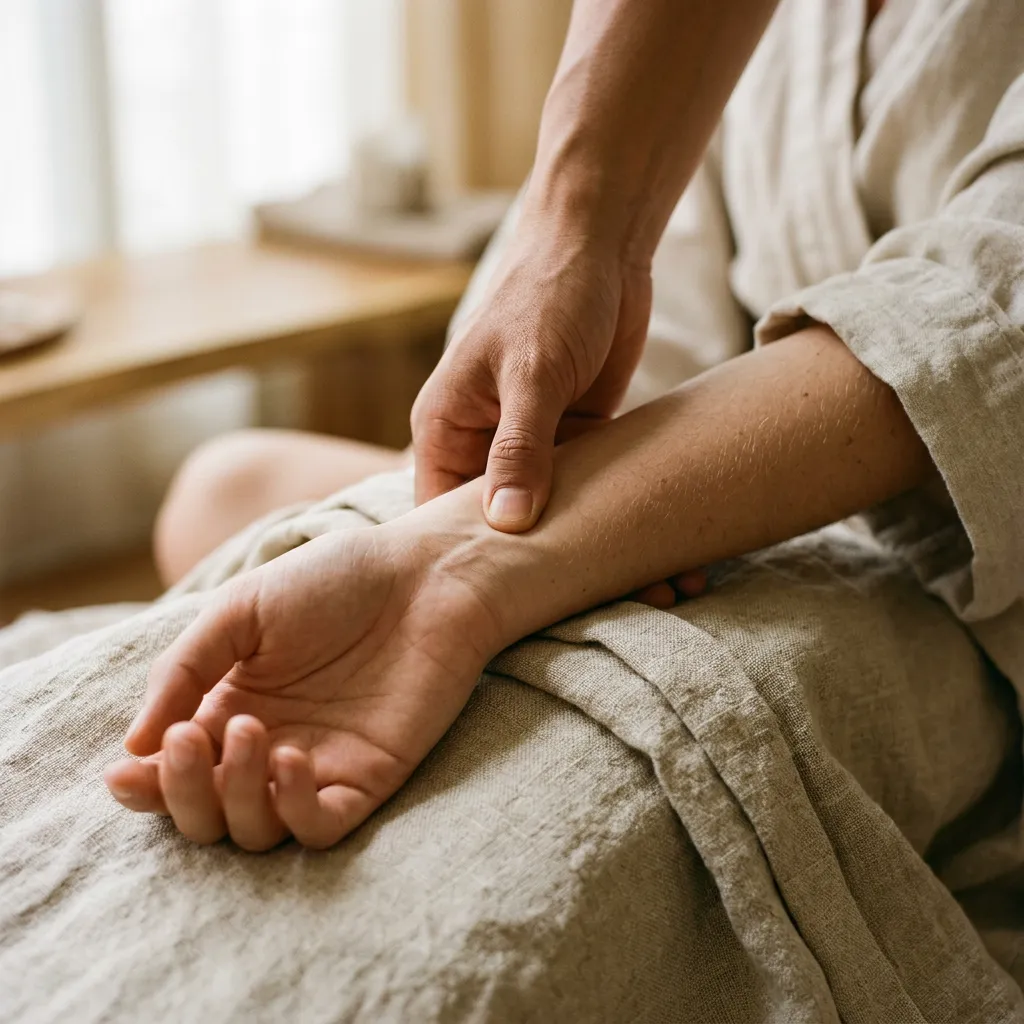
Carpal tunnel syndrome happens when the median nerve, which runs from the forearm through the wrist into the palm, is pressed or squeezed at the wrist. The carpal tunnel itself is a narrow, rigid passage of bone and ligament at the base of the hand, shared by that nerve and the tendons that bend your fingers. When the space tightens, the nerve complains first.
The median nerve gives feeling to the thumb, index finger, middle finger and part of the ring finger — but not the little finger — and it runs some small muscles at the base of the thumb. That map explains the classic pattern described by the National Institute of Arthritis and Musculoskeletal and Skin Diseases (NIAMS): numbness or tingling that starts slowly in those fingers, often first at night, with an urge on waking to shake the hand out. Later it shows up during the day — holding a phone, reading, driving. The American Academy of Orthopaedic Surgeons (AAOS) adds burning, occasional shock-like jolts, pain that can travel up the forearm, clumsiness with buttons, and dropping things.
Left untreated, symptoms can become constant, and the muscles at the base of the thumb can weaken until gripping small objects is hard. That progression is why early evaluation matters more here than with an ordinary muscle ache.
Is the keyboard to blame?
Less clearly than most people assume. Neither NIAMS nor AAOS names typing as a cause. AAOS lists repetitive hand use and holding the wrist sharply bent for long periods as risk factors, alongside heredity — some people simply have a smaller tunnel — pregnancy, diabetes, rheumatoid arthritis and thyroid problems, and NIAMS adds wrist injury, vibrating tools and fluid retention during pregnancy or menopause. Women are more likely to develop it. A desk can aggravate symptoms through wrist position even when it did not start them; our guide to desk-job neck and back pain covers the workstation side.
Little finger tingling? Look higher up the arm
Because the median nerve skips the little finger, numbness there points somewhere else — often the ulnar nerve at the elbow, or a nerve root in the neck. Neck pain, symptoms running the whole length of the arm, or tingling that changes as you turn your head are reasons to have the neck examined; NIAMS notes that physicians check the hands, arms, shoulders and neck to rule out other causes. Our neck and shoulder pain page covers that territory.
— 02
Physician first: testing, splints and surgery.
A physician should evaluate hand numbness before any acupuncture, because NIAMS stresses that early diagnosis and treatment help avoid further damage to the median nerve. Most cases are diagnosed with a physical exam — tapping or pressing over the nerve, bending the wrist, testing fingertip sensation and thumb strength — and some need nerve testing to confirm how severe the problem is.
That testing is worth understanding. A nerve conduction study measures whether signals slow down as they cross the carpal tunnel; electromyography (EMG) gauges any muscle damage; ultrasound can show a swollen nerve; and lab work or X-rays look for fractures, arthritis or diabetes. Together they tell your physician how far along things are, which decides what comes next.
| Option | What it does | What the sources say |
|---|---|---|
| Night splint | Holds the wrist straight while you sleep | A common first treatment (NIAMS); a neutral wrist reduces pressure on the nerve (AAOS) |
| Activity changes and breaks | Less repetitive gripping, fewer long stretches with the wrist bent | Modifying aggravating activities can help slow or stop progression (AAOS) |
| Anti-inflammatory medicine | Ibuprofen or naproxen for pain | Can relieve pain and inflammation (AAOS) |
| Nerve gliding exercises | Gentle movements that help the nerve slide within the tunnel | Some patients may benefit (AAOS) |
| Steroid injection | Anti-inflammatory medicine placed into the tunnel | Often relieves symptoms, but usually only temporarily (NIAMS, AAOS) |
| Release surgery | Cuts the ligament forming the tunnel's roof to make room for the nerve | One of the most common operations in the U.S.; recurrence is very rare (NIAMS) |
NIAMS makes one point every patient deserves to hear: nonsurgical treatments can improve symptoms in the short term, but they do not fix the underlying problem with the nerve. Acupuncture is a nonsurgical treatment, and the same honesty applies to it. When numbness is long-standing and constant and the thumb muscles are wasting, AAOS says surgery may be recommended to prevent irreversible damage — and in that situation, needles are not a reason to wait. After surgery, grip and pinch strength usually return by about 2 to 3 months, though in severe cases fingertip sensation can take 6 to 12 months to recover.
— 03
How acupuncture fits around the wrist.

Acupuncture has a narrow, supporting role in carpal tunnel care: easing pain, tingling and the forearm tightness that comes with them while a splint and your physician's plan do the structural work. It suits people with mild or on-and-off symptoms, people waiting on nerve testing, and people who have agreed with their doctor to try conservative care first.
Where the needles go
Traditional Chinese Medicine (TCM) maps the Pericardium channel straight down the center of the inner forearm and across the wrist crease, which puts two of its classic points directly over this problem: PC7 (Daling) sits in the middle of the wrist crease between the two central tendons, and PC6 (Neiguan) about two thumb-widths above it. Treatments typically add points on the thumb side of the wrist and the back of the hand, points along the forearm muscles that grip and type all day, and often points at the elbow, shoulder and neck — because the nerve's whole route matters, not just its tightest spot.
Expect a dull ache or heaviness at most points. Near the wrist, a needle can occasionally send a brief tingle into the fingers; tell your practitioner straight away if anything feels sharp or electric, and the needle is adjusted. The proposed mechanisms are the same ones studied for other pain — local blood flow, release of tight muscle, and changes in how the nervous system processes pain signals — and none of them widens the tunnel.
Hands-on work for the forearm
Many desk workers carry as much tension in the forearm, shoulder and neck as at the wrist. A 60 minute tui na massage works that whole chain by hand for $100, or $80 at the member rate that comes with buying a package of 5 or more massage sessions (no fee, no signup). Pressure over the wrist itself should stay gentle; deep pressure on an irritated nerve is not the goal, so say so if anything there feels sharp.
— 04
What research shows — and its limits
The evidence for acupuncture in carpal tunnel syndrome is modest and mixed, and the National Center for Complementary and Integrative Health (NCCIH) summary is the place to start. A 2018 review of 12 studies with 869 participants concluded that acupuncture and laser acupuncture may have little or no effect on symptoms compared with sham acupuncture.
NCCIH adds that it is uncertain how acupuncture compares with other treatments for the condition. It also describes a 2017 study of 80 participants in which local, distal and sham treatment all reduced symptom severity, while the real-needle groups showed more favorable changes in the wrist and brain. That trial used electroacupuncture — needles carrying a mild electrical current — which is not on our menu, so we do not borrow its results.
Put plainly: some people report that acupuncture takes the edge off night tingling and forearm ache, but controlled research has not shown it beats a convincing placebo, and nothing suggests it reverses nerve compression. If your physician has found significant nerve changes on testing, follow that plan. Where acupuncture can reasonably earn a place is as a low-risk addition for mild symptoms — NCCIH notes relatively few complications have been reported, and the U.S. Food and Drug Administration (FDA) requires acupuncture needles to be sterile and labeled for single use.
How to judge a trial honestly
- Night wakings — how many nights a week tingling wakes you
- Morning shake-out — whether you still need to shake the hand awake
- Fine tasks — buttons, earrings, picking a coin off a table
- Drops — anything that slipped from your grip this week
Write those down before your first session and again after the 5 session package. If the numbers have not moved, that is useful information to take to your physician — and our signal to stop rather than book more.
— 05
Red flags, insurance and booking.
Some hand symptoms need a physician quickly rather than a course of acupuncture, and a few are emergencies. Get medical care first — calling 911 where noted — if you have:
- Numbness that never lets up, day and night
- Weakness or visible thinning of the muscle at the base of the thumb, or a weak pinch
- Repeatedly dropping things, or losing track of where your hand is
- Symptoms after a fall or wrist injury — a possible fracture needs imaging
- Sudden onset with neck pain, or weakness spreading through the arm
- Numbness in both hands and both feet — worth checking for diabetes or another body-wide nerve cause
- Sudden numbness or weakness on one side of the body or face, trouble speaking, or a drooping face — call 911
Coverage for these visits depends on your plan. Medicare is out — it pays for acupuncture only for chronic low back pain. UnitedHealthcare and Aetna are the commercial plans we accept for acupuncture, and benefits differ from policy to policy, so text the details to 240-715-5939 and we will run a free benefits check before your first visit. Massage is self-pay. The insurance page explains how coverage usually works.
New to acupuncture? The new patient guide walks through a first visit, and our McLean acupuncture clinic page has hours, parking and directions to Chain Bridge Rd. When you are ready, book a first visit for carpal tunnel symptoms — and bring your splint, plus any nerve study results you already have.
— Pricing
| Acupuncture | Price |
|---|---|
| Initial session · 60 minutes | $150 |
| Follow-up session · 30 minutes | $100 |
| Package · 5 sessions (30 minutes each)($80 per visit) | $400 |
Insurance patients: sessions are billed through your plan — text us your policy info for a free benefits check.
Parking & arrival
Free parking — easy in, easy out on Chain Bridge Rd
Open every day 9 AM – 9 PM — lunch-break, after-work, and weekend visits all fit.
- Park free directly on-site at 1481 Chain Bridge Rd, Ste 300 — no garages, no meters.
- Look for the red-brick building; we're in Ste 300 with signage at the entrance.
- Arrive 10 minutes early for your first visit to settle in — WiFi and a snack bar are waiting.
— Questions
Asked & answered.
Can acupuncture cure carpal tunnel syndrome?
No. Acupuncture does not widen the carpal tunnel or take pressure off the median nerve, and a 2018 review summarized by NCCIH concluded it may have little or no effect on symptoms compared with sham needling. What some people report is easier nights and less forearm ache while a splint and their physician's plan do the structural work. Treat it as a supporting option, not a cure.
Should I keep wearing my wrist splint during acupuncture?
Yes. A night splint that holds the wrist straight is one of the most common first treatments for carpal tunnel, and nothing about acupuncture replaces it. Wear it as your physician advised, keep up any nerve gliding exercises you were given, and tell your practitioner what else you are doing so treatment fits around it.
Will acupuncture help me avoid carpal tunnel surgery?
Nobody can honestly promise that. AAOS says surgery may be recommended when nonsurgical care brings no lasting relief, when testing shows significant nerve changes, or when numbness is constant and the thumb muscles are wasting — framing that last case as preventing irreversible damage. If your physician recommends release surgery for those reasons, acupuncture is not a reason to wait.
Do the needles go into the wrist itself?
A few go near it — typically at the wrist crease and just above it on the inner forearm — with others on the back of the hand, along the forearm and sometimes at the elbow, shoulder and neck. The needles are hair-thin. A brief tingle into the fingers can happen close to the nerve; mention anything sharp or electric straight away.
Is it carpal tunnel or a pinched nerve in my neck?
The fingers involved give a strong clue. The median nerve supplies the thumb, index, middle and part of the ring finger, not the little finger, so tingling in the little finger, neck pain or symptoms down the whole arm suggest a different source. A physician's exam and nerve conduction testing settle the question — worth doing before any treatment plan.
How soon might I notice a difference?
There is no research-backed timeline for acupuncture and carpal tunnel, so treat it as a defined trial. Note your night wakings and morning shake-outs before you start, then compare after the initial visit and the 5 session package ($400, or $80 per visit). If nothing has changed, we will say so and suggest you take that record back to your physician.
— Research & references
NCCIH — Acupuncture: Effectiveness and Safety
Summarizes a 2018 review of 12 studies suggesting acupuncture may have little or no effect on carpal tunnel symptoms compared with sham treatment.
NIAMS — Carpal Tunnel Syndrome
Explains how the median nerve is squeezed at the wrist, which fingers it supplies, and why symptoms often start at night.
NIAMS — Carpal Tunnel Syndrome: Diagnosis, Treatment, and Steps to Take
Covers nerve testing, night splinting and surgery, and notes that nonsurgical treatments may help only in the short term.
AAOS OrthoInfo — Carpal Tunnel Syndrome
Describes risk factors, nonsurgical options, and when surgery may be recommended to prevent irreversible nerve damage.
Citations are summarized — please consult the original sources. This page is general health education, not medical advice for your specific case; results vary and acupuncture works best alongside, not instead of, care from your physician.
— Keep exploring
Condition
Neck & Shoulder Pain
When arm tingling starts at the neck rather than the wrist.
Guide
Desk-Job Neck & Back Pain
What the research says about acupuncture for screen-bound bodies.
Service
Tui Na Meridian Massage
Hands-on work for the forearm, shoulder and neck chain.
Location
Acupuncture in McLean, VA
1481 Chain Bridge Rd — pricing, hours and directions in one place.